Last updated: April 2026
This guide covers what AI in procurement actually means in practice, the use cases delivering the most value in 2026, how to approach implementation, and what the shift to Agentic AI means for enterprise procurement teams. Whether you are building the business case internally or evaluating where to start, this is the reference point.
AI technology has existed in various forms for a decade, but the cost of deployment has dropped substantially, the capability of large language models has increased, and the pressure on procurement teams has grown. Procurement workloads grew by 10% while budgets grew by just 1% last year, creating a 9% efficiency gap that most teams cannot close through hiring alone (Hackett, 2025). AI in procurement is where the answer is being found.
Traditional procurement automation, such as robotic process automation, follows fixed rules. It can copy data between systems, trigger approval workflows above a threshold, or generate standard purchase orders, but when conditions change, the rules break and the system has no mechanism to adapt.
AI systems work on a different principle: they learn from data rather than executing a fixed instruction set. A rule-based tool requires every condition to be defined in advance by a human. A machine learning model finds patterns in historical data and generalises from them, so when it encounters a supplier category it has never seen before, it can still make a reasonable classification rather than failing. That capacity to generalise is what separates AI systems from automation.
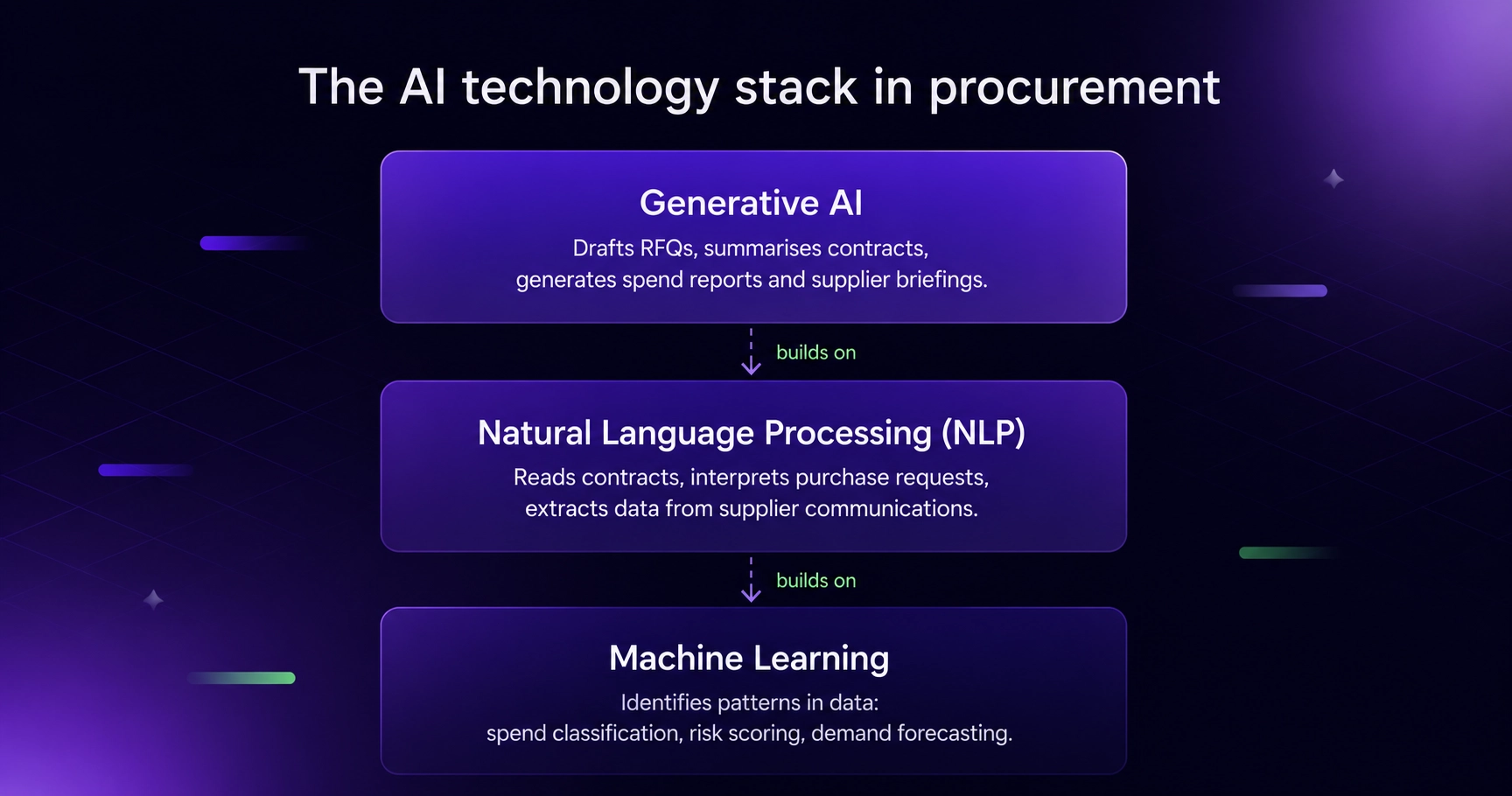
Procurement AI operates across three distinct capability layers.
Machine Learning: Machine learning algorithms identify patterns in large volumes of historical data. In procurement, this underpins spend classification, supplier risk scoring, demand forecasting, and anomaly detection across procurement data. The more data the model sees, the more accurate its outputs become.
Natural language processing (NLP): NLP enables artificial intelligence systems to read, interpret, and act on human language. In procurement, NLP powers contract review, intake tools that understand purchase requests in plain language, and supplier communication tools that extract structured data from unstructured email threads.
Generative AI: Where machine learning classifies and NLP reads, generative AI produces new content. Rather than analysing existing data or interpreting text, it generates new content from a prompt. In procurement, this means drafting RFQ and RFP documents, summarising contracts, creating natural-language spend reports, and producing supplier briefings. It is the layer that has drawn the most attention from chief procurement officers in the past two years.
AI technology in procurement has moved past the question of whether to adopt and into the harder question of how to scale. Most large procurement organisations have run at least one AI project. Fewer have built something that runs reliably in production. The reasons are structural: fragmented data, change management challenges that no technology purchase resolves on its own, and unresolved governance questions about who owns AI outputs that carry commercial or legal weight.
Together, these figures describe an industry that has accepted AI as inevitable but has not yet found a consistent path from pilot to production. The procurement organisations that close this gap fastest will not be those with the most ambitious plans, but those that address the preconditions first.
Data readiness is the first barrier, and it has two dimensions. The first is quality: most procurement organisations are sitting on years of data that was never consistently structured or maintained, with spend categories that differ by region, supplier records with duplicate entries, and contracts missing key fields. The second is architecture: most procurement functions run on five to ten separate point solutions, none of which were designed to share a data model. AI needs consistent, connected data to work reliably across a process. Without it, even well-trained models cannot make decisions that are accurate beyond the boundaries of a single system.
Change resistance is the second barrier. Procurement roles built around specific manual tasks need to be redesigned when those tasks are automated. Without structured support and clear communication about what AI is replacing, adoption rates stay low even when the technology works as promised.
Governance is the third barrier in AI procurement processes, and often the least visible until a project is already in trouble. When AI agents produce outputs that carry commercial or legal weight, someone in the organisation needs to be accountable for validating those outputs. Most procurement teams have not yet established who that is, which approval thresholds apply, or how AI-assisted decisions are documented for audit purposes. Without a governance framework, even well-designed AI deployments stall at the point of production.
AI use cases in procurement span a wide range, from tasks where AI provides analytical support on repetitive tasks to procurement processes that run largely without manual intervention. The nine use cases below focus on the highest-value applications in 2026, ordered from data-driven foundations through to the most advanced agentic applications.
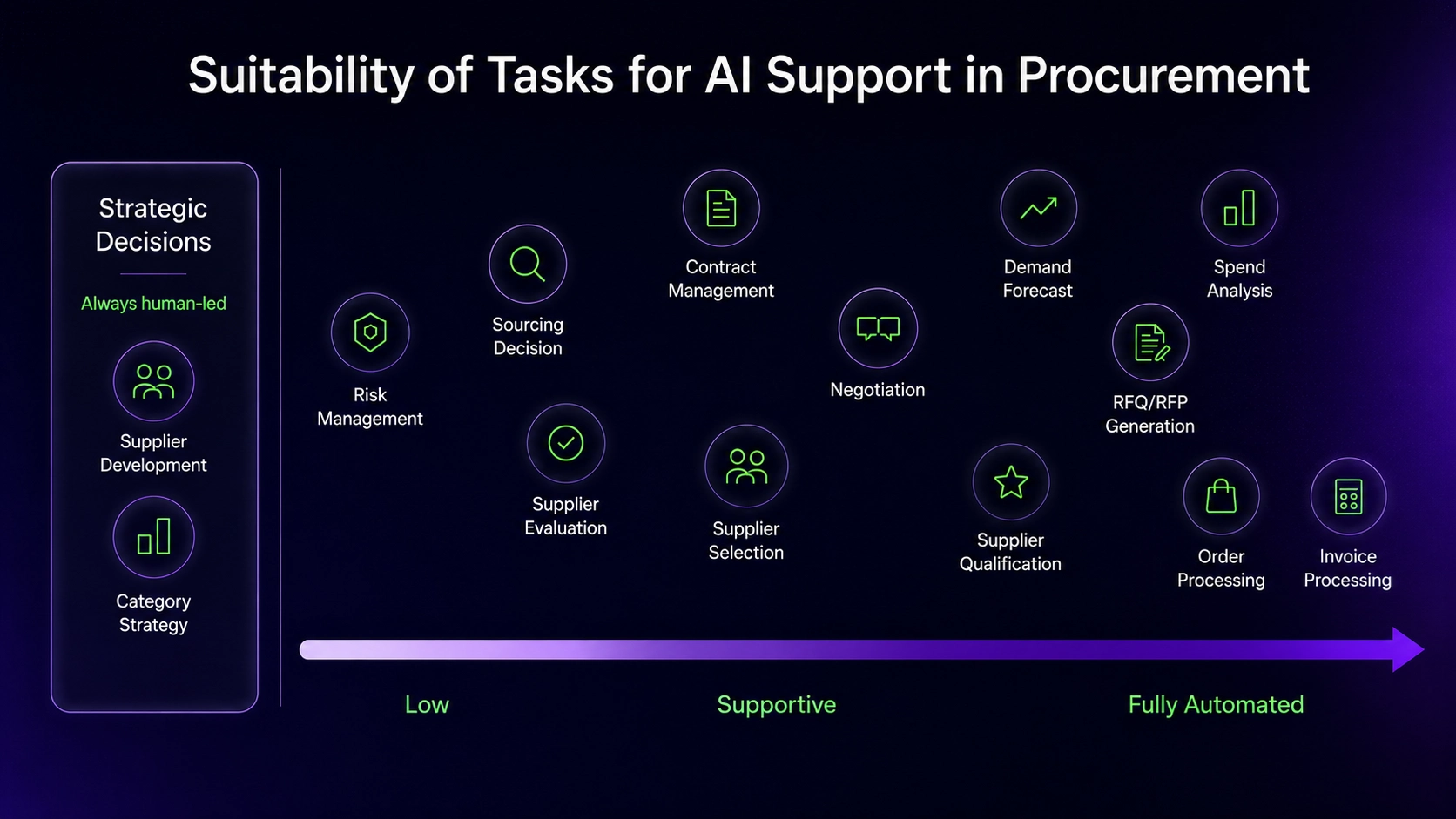
AI-powered spend analysis automates the work of cleansing, classifying, and enriching spend data. Machine learning algorithms improve classification accuracy through feedback loops on historical data, enabling organisations to categorise millions of transactions without manual effort. Procurement teams get a live picture of where their spend is going, which contracts are being used, and where cost savings opportunities exist, enabling faster and better-informed decision making across spend categories.
Generative AI drafts RFQ and RFP documents from a plain-language requirement description. In agent-based sourcing workflows like Mercanis's Quick RFQ, the process goes further: AI agents contact suppliers, collect bids, and negotiate across multiple rounds while the buyer sets the strategy upfront and reviews the outcome. This is particularly relevant for technical spend, C-parts, and smaller services where manual negotiation is too resource-intensive relative to contract value.
AI algorithms continuously monitor external data sources to identify signals of supplier risk before they escalate, covering financial instability, supply chain disruptions, regulatory changes, and sustainability incidents. These systems produce real-time risk scores on supplier creditworthiness, supplier performance, cyber health, and sustainability standing, scanning global data for market trends and operational disruptions. AI-supported supplier relationship management means procurement teams receive alerts rather than discovering problems in quarterly reviews.
AI consolidates supplier information from existing system components, including ERP data, into a central supplier database. It then automatically enriches these profiles from online sources: supplier articles, reviews, contact details, certifications, and core competency signals. The result is a complete, continuously updated supplier profile including supplier performance history in one place, rather than data spread across systems and manually maintained spreadsheets. For procurement teams evaluating suppliers or preparing for sourcing events, this removes the information-gathering step that would otherwise take hours per supplier.
AI in contract management reads existing contracts at scale and monitors contracts over time. On the extraction side, AI pulls key terms, obligations, and certifications from archives that previously lived as untagged PDFs. On the monitoring side, it flags deviations and tracks obligation deadlines, helping procurement teams surface exposure before it becomes a problem.
AI-powered procurement intake turns an unstructured purchase request into a fully structured workflow entry without manual intervention. The Intake Agent asks the right questions based on category, spend level, and supplier status, applies approval logic and sourcing rules automatically, and routes the request directly into sourcing or supplier management, eliminating the manual handoffs and back-and-forth that slow most intake processes down.
AI in invoice processing captures data from incoming invoices, matches them against purchase orders and delivery confirmations, and routes discrepancies for human review. Three-way matching that previously required manual data entry runs at volume, with exceptions flagged rather than everything processed by hand.
Machine learning models that analyse historical purchasing patterns, sales forecasts, supplier lead times, and external market data produce more accurate demand signals than spreadsheet-based planning. For procurement organisations managing categories with price volatility or supply chain complexity, better forecasts translate into better buying decisions and lower inventory carrying costs.
Negotiation agents execute the back-and-forth of supplier price negotiations autonomously, within parameters set and approved by the procurement team. The agent handles the communication, the offer and counter-offer logic, and the documentation of agreed terms. The buyer defines the guardrails, reviews the outcome, and retains full decision making authority on anything outside the pre-approved range. The cost savings arise because manual negotiation is uneconomical for smaller contracts and C-parts. AI makes it viable to negotiate categories that were previously left at list price, capturing savings across procurement operations that were previously out of reach.
Generative AI refers specifically to AI systems that create outputs rather than classify or route inputs. In procurement, this means producing documents, summaries, analyses, and structured responses in natural language. The practical difference from earlier AI in procurement is that generative AI can work with unstructured inputs and generate new content rather than making decisions about existing data.
Generative AI works alongside analytical AI rather than replacing it: a machine learning model might identify that a supplier category carries elevated risk, and a generative AI system then drafts the communication to that supplier or produces the briefing document for the procurement committee.
The most widely adopted gen AI applications in enterprise procurement as of 2026 are document generation for sourcing events, contract summarisation, and natural language reporting. Each had previously required procurement professionals to write from scratch or specialist staff to interpret system outputs. For routine cases, gen AI compresses that work considerably, freeing procurement professionals for negotiation, supplier strategy, and cross-functional work where their judgement is genuinely needed.
Spend analytics and dashboarding leads as the top gen AI investment priority for chief procurement officers at 53%, driven by demand for on-demand visibility without waiting for quarterly reporting cycles. RFP and RFQ generation follows at 42%, where volume pressure in indirect procurement is highest. Contract summarisation at 41% reflects the scale of legacy contract archives that most large organisations are still working through systematically (Deloitte, 2025).
Agentic AI represents the stage beyond task automation in procurement AI. Where a generative AI tool responds to a prompt and produces an output, an AI agent takes initiative: it identifies what needs to be done, takes a sequence of actions across connected systems, and passes the result to the next step in a workflow, with minimal human instruction between steps. This shifts decision making from individual steps to strategic oversight.
This distinction matters for procurement because procurement is not a set of isolated tasks. It is a connected sequence: a purchase request triggers a supplier search, which triggers an RFQ, which triggers offer comparison, negotiation, award, contract creation, onboarding, and monitoring. Automating individual steps helps. Automating the handoffs between them is where procurement workflows genuinely accelerate.
When something unexpected happens, a well-designed agent either handles it within its operating parameters or escalates with context already prepared, maintaining data quality and accuracy across the workflow. An AI agent handling supplier onboarding, for example, can coordinate document collection, compliance checks, system registration, and contract execution as a continuous process rather than a series of manual handoffs between people and systems.
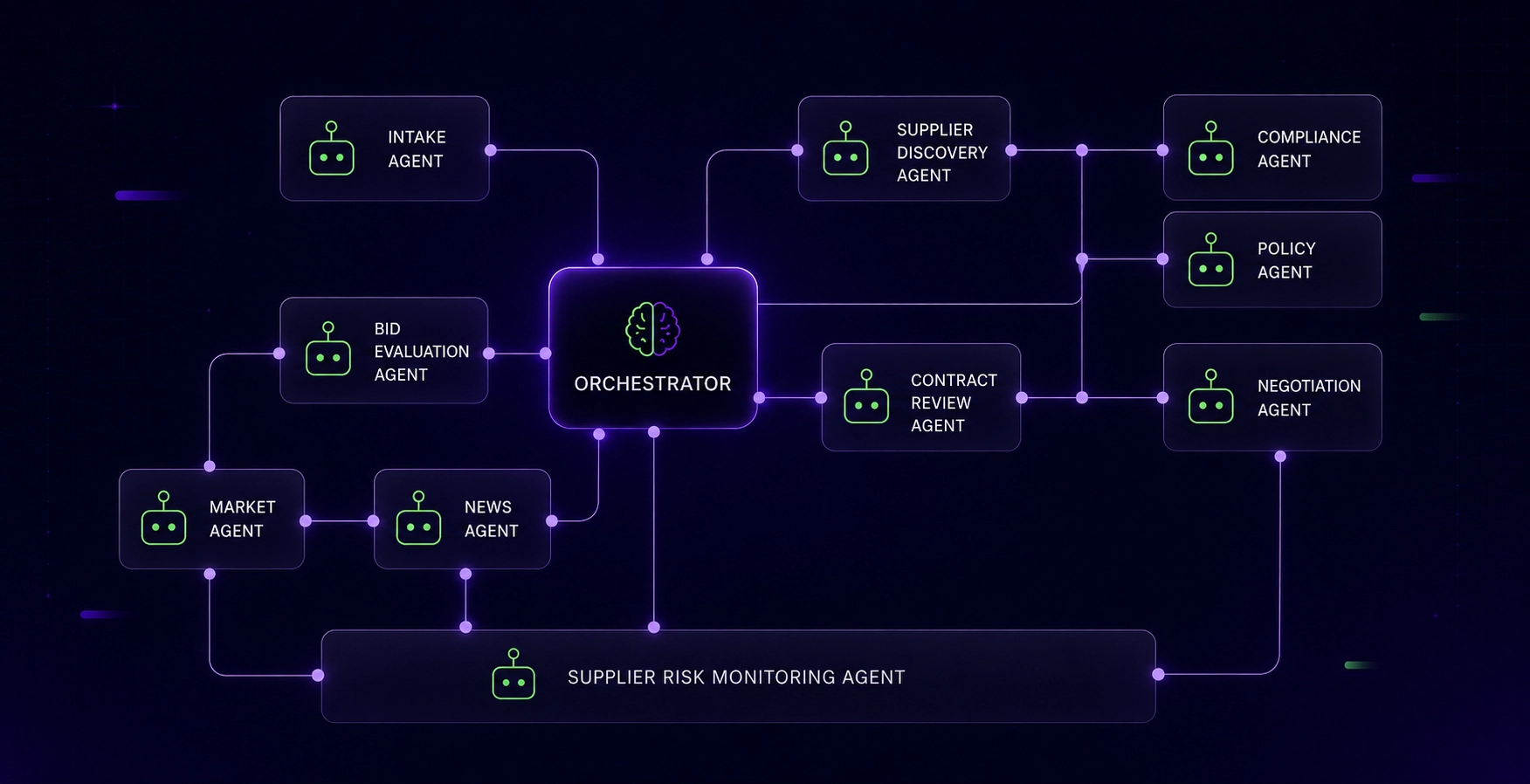
The practical form of agentic procurement AI is the multi-agent workflow: multiple agents running simultaneously across different procurement processes, while one handles an incoming purchase request, another is converting a requirement into a structured tender, and a third is identifying new supplier alternatives in the background. There is no waiting between steps, no manual handover, no dependency on a single person to trigger the next action. This parallel execution is what makes agentic procurement fundamentally different from automating individual tasks. Agentic AI can also continuously monitor purchasing behaviour against procurement policies and respond automatically, enforcing compliance rules without manual intervention.
Mercanis is built on this principle: specialised agents work across sourcing, supplier management, contracts, and intake on a shared data foundation, with the buyer setting the direction and reviewing outcomes. For a full breakdown of how multi-agent orchestration works, see the guide to agentic procurement orchestration.
Most AI implementations in procurement that fall short do not fail because the technology does not work. They fail because the operating model was not ready for it and the preconditions for AI are more demanding than most organisations expect at the outset.
The most important implementation decision is choosing which procurement problem to solve first, and being specific about what success looks like. "We want to automate procurement" is not a useful starting point. "We want to reduce sourcing cycle time for indirect categories from 14 days to 5 days, measured from approved intake to contract award" gives the programme something to optimise against. The operating model is the real bottleneck, and defining outcomes forces clarity on that before technology selection begins.
A unified data foundation, where spend data, supplier master data, contract data, and intake data are normalised and accessible, is the prerequisite for AI agents to function reliably. Teams that deploy AI tools before addressing data quality find that outputs are unreliable, and trust in the system erodes quickly. Cleaning and consolidating procurement data is unglamorous work, but it cannot be deferred.
That said, organisations do not need to wait for perfect data before starting. AI can actively help improve data quality over time. Machine learning models reclassify spend that previously sat as uncategorised, getting more accurate with every correction. Duplicate supplier records get identified and consolidated automatically. Missing fields in supplier profiles are enriched from external sources. Anomalies in invoice data are flagged rather than silently processed. The baseline needs to be sufficient to start, but AI itself becomes part of the process that makes the data better.
Siloed AI deployment is the leading structural barrier to AI value delivery in procurement. When procurement acts without IT involvement, data access is fragmented. When finance is not aligned, cost savings do not get captured correctly. When legal has not reviewed AI-assisted contract tools, the organisation carries risk it cannot account for. Effective AI in procurement requires procurement, IT, finance, legal, and business unit stakeholders to be aligned from the start of implementation, not brought in once problems emerge.
Human oversight is not a limitation on AI. It is the mechanism by which errors are caught, models improve, and the organisation builds justified confidence in AI outputs over time. A practical implementation principle is trust-but-verify: AI agents handle operational execution, but humans review outputs at defined checkpoints, particularly for decisions with significant financial or legal consequences. This approach makes AI reliable at scale across procurement processes rather than just impressive in a demo. For a practical framework on how to make this work in enterprise procurement, see Making AI Agents in Procurement Trustworthy.
Procurement professionals need more than a tools training session to work effectively alongside AI systems. They need to develop new working patterns: knowing which tasks to delegate to AI agents, how to evaluate AI outputs critically, and when to escalate. Organisations that redesign workflows alongside training see materially higher adoption than those that run training in isolation.
Beyond the barriers covered above, including data readiness, fragmented tool landscapes, change resistance, and governance, two risks deserve specific attention because they are less visible during the evaluation phase and often only surface after deployment: data security and hallucinations.
Procurement data includes commercially sensitive pricing, supplier financial information, and contract terms. When artificial intelligence tools access this data, organisations need clarity on where data is stored, whether it is used to train shared models, and what protections exist against exposure to third parties or other customers. Not all AI tools and procurement platforms carry equivalent security assurances. AI technology vendors differ significantly in their compliance certifications, and this is worth scrutinising before deployment.
Hallucinations in procurement AI occur when a model presents fabricated information with complete confidence: a supplier price that does not exist, a contract clause that was never agreed, a delivery term invented from statistical probability rather than the actual document. The root cause is most often architectural. Agents that operate without access to live procurement data have nothing concrete to anchor their outputs to. Data grounding solves this by connecting agents directly to verified data sources, so that outputs are derived from what is in the system rather than what the model calculates as probable. Architecturally grounded systems with defined guardrails fail far less frequently than isolated agents working without that foundation.
The most common question about AI in procurement is whether it will displace the people working in it. The evidence from procurement teams that have deployed AI at scale points consistently in the other direction. Procurement functions that run AI agents are not smaller. They are handling significantly more volume with the same headcount, and the work that remains for humans is more commercially valuable.
The operational and repetitive tasks that AI handles well across procurement operations, including manual data entry, document creation, offer comparison, routine approvals, and supplier communication follow-up, are the tasks that have historically consumed the largest share of procurement capacity. When AI agents handle these, procurement teams gain time for areas like supplier relationships, strategic negotiations, and a greater focus on supply chain resilience, where human judgement is not optional.
The shift from transactional to strategic procurement has been an ambition for the industry for years. AI in procurement is the operational mechanism that is making it practical at scale. The 10x Buyer model, from Mercanis's AI Playbook for Procurement Leaders 2026, describes a procurement professional whose output is multiplied because AI agents handle the operational execution under their oversight. The important decisions remain firmly with the human. The agent executes the operational work, and the buyer drives the strategic work.

AI is used across the full procurement lifecycle by procurement teams of all sizes. Where earlier automation relied on robotic process automation and rule-based tools, today's AI handles unstructured inputs, learns from data, and operates through specialised AI agents autonomously. The most established applications are spend analysis and classification, RFQ and RFP generation, supplier risk monitoring, contract review and extraction, intake routing, invoice processing, and negotiation. Each use case sits at a different point on the automation spectrum, from AI-supported decision-making to processes that run largely without manual intervention.
The 30% rule in artificial intelligence is a general heuristic rather than a formal standard. It suggests that AI should handle approximately 70% of repetitive, data-heavy work while humans retain 30% for oversight, judgement, and decisions that require context. In procurement, this maps closely to how well-designed AI deployments already work: agents handle operational execution across sourcing, intake, and processing, while buyers retain responsibility for supplier strategy, negotiation parameters, and commercial decision making.
AI is not taking over procurement. It is taking over specific tasks within procurement: the administrative and operational work that procurement professionals have historically found least valuable and most time-consuming. The functions that define the commercial impact of a procurement team, including supplier strategy, category management, negotiation, cross-functional influence, and risk judgement, are not areas where AI operates autonomously. Core procurement processes still require human expertise to deliver value. Human oversight is built into every serious AI procurement deployment for exactly this reason. What AI enables is a shift from procurement as an operational function to procurement as a strategic one. That requires more human expertise, applied to higher-value work.
The 5 P's of procurement refer to five principles that govern sound purchasing decisions: the right Product, at the right Price, from the right Place or supplier, in the right quantity, at the right time. The framework is also described as the "Five Rights of Procurement" across different procurement textbooks and standards bodies, and the exact formulation varies by source. It predates AI entirely and remains a useful reference point for evaluating whether AI-assisted procurement decisions are aligned with fundamental purchasing objectives. AI tools should be assessed against these principles rather than treated as a substitute for them.


Fabian Heinrich is the CEO and co-founder of Mercanis. Previously he co-founded and grew the procurement company Scoutbee to become a global market leader in scouting with offices in Europe and the USA and serving clients like Siemens, Audi, Unilever. With a Bachelor's degree and a Master's in Accounting and Finance from the University of St. Gallen, his career spans roles at Deloitte and Rocket Internet SE.