The procurement process hasn't changed structurally in decades. Every step still waits for a person to pass it to the next. Purchase requests queue behind approvals that wait on supplier checks that depend on data no one has centralised. None of these steps are difficult on its own, but together they take days.
Agentic procurement orchestration addresses that sequence directly. Specialised AI Agents handle each step autonomously and pass the task forward without waiting for human intervention. The CPO gets a decision-ready summary. McKinsey estimates that agentic AI can make procurement operations up to 40% more efficient, a number that is already showing up in production deployments.
This is different from standard procurement automation. Rule-based automation follows fixed conditions: if X, then Y. Agentic orchestration sets a goal and lets agents determine how to reach it, adapting as conditions change. Agentic workflows operate on continuous sense-plan-act-learn loops, which is what allows them to reassess and adjust when conditions change mid-process. A rule-based system sends a notification when a supplier's price exceeds a threshold. An orchestrated agent evaluates whether that price change signals a broader supply risk, checks alternatives, and routes a recommendation before anyone has to ask.
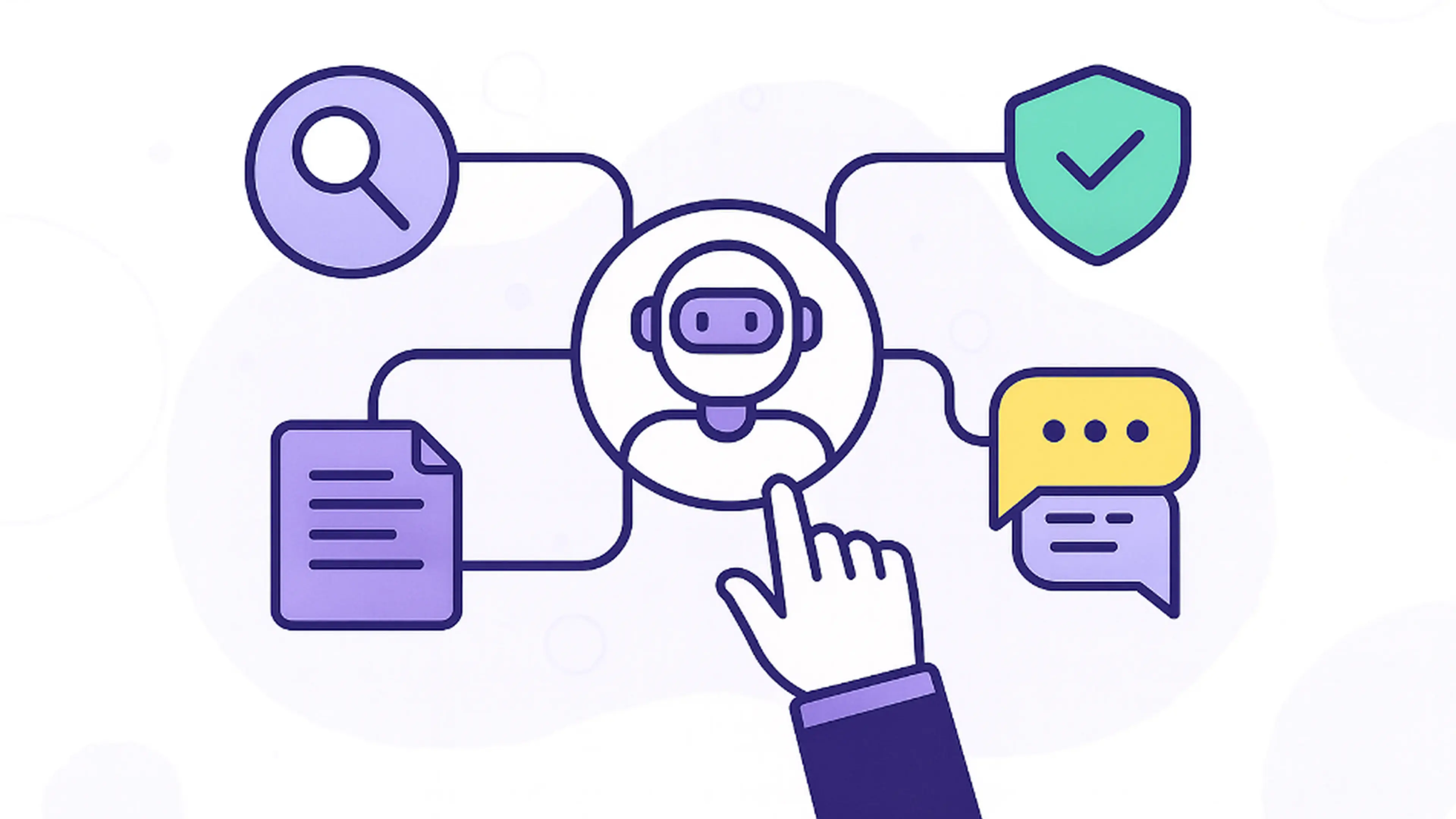
It is also different from a single AI assistant or chatbot. One model handles one query. Orchestration means multiple specialised agents working across the full procurement lifecycle, each accountable for a specific domain, coordinated by a central orchestration layer. That layer decides which agent acts when, passes each output forward to the next stage, and keeps the shared context intact throughout.
This orchestration layer sits between the systems of record (ERP, SRM) and the systems of engagement (sourcing events, approvals) and ensures that information moves through the procurement process automatically. Each procurement tool typically manages its own data. The challenge has always been getting that data to flow between them, without manual intervention. Orchestration is what makes that flow happen.
Each agent in an orchestrated procurement system owns a specific part of the process. At the intake stage, an agent validates purchase requests, checks budgets, and routes for approval based on context. Further along the chain, supplier discovery happens automatically: agents search market databases for potential vendors and evaluate them against defined criteria. Incoming bids are compared across price, terms, and structure, with a ranked recommendation surfaced before the buyer needs to ask. Contract clauses get reviewed for risk, key renewal dates tracked. Contract discrepancies are a leading cause of value leakage, and this is precisely where automated review catches what manual processes miss. A negotiation agent rounds out the sequence, working from market data and defined parameters, either autonomously or preparing responses for human review.
Supplier risk management is where orchestration adds a dimension that manual procurement rarely has capacity for. An agent monitoring supplier health tracks financial indicators, ESG compliance, delivery performance, and geopolitical exposure across hundreds of suppliers simultaneously. Issues that would take a buyer days to identify manually surface as alerts before they become supply chain disruptions. That level of continuous oversight across the full supplier base is not achievable without automation. By handling routine supplier management tasks autonomously, agents free procurement professionals to focus on building stronger supplier partnerships and more strategic relationships.
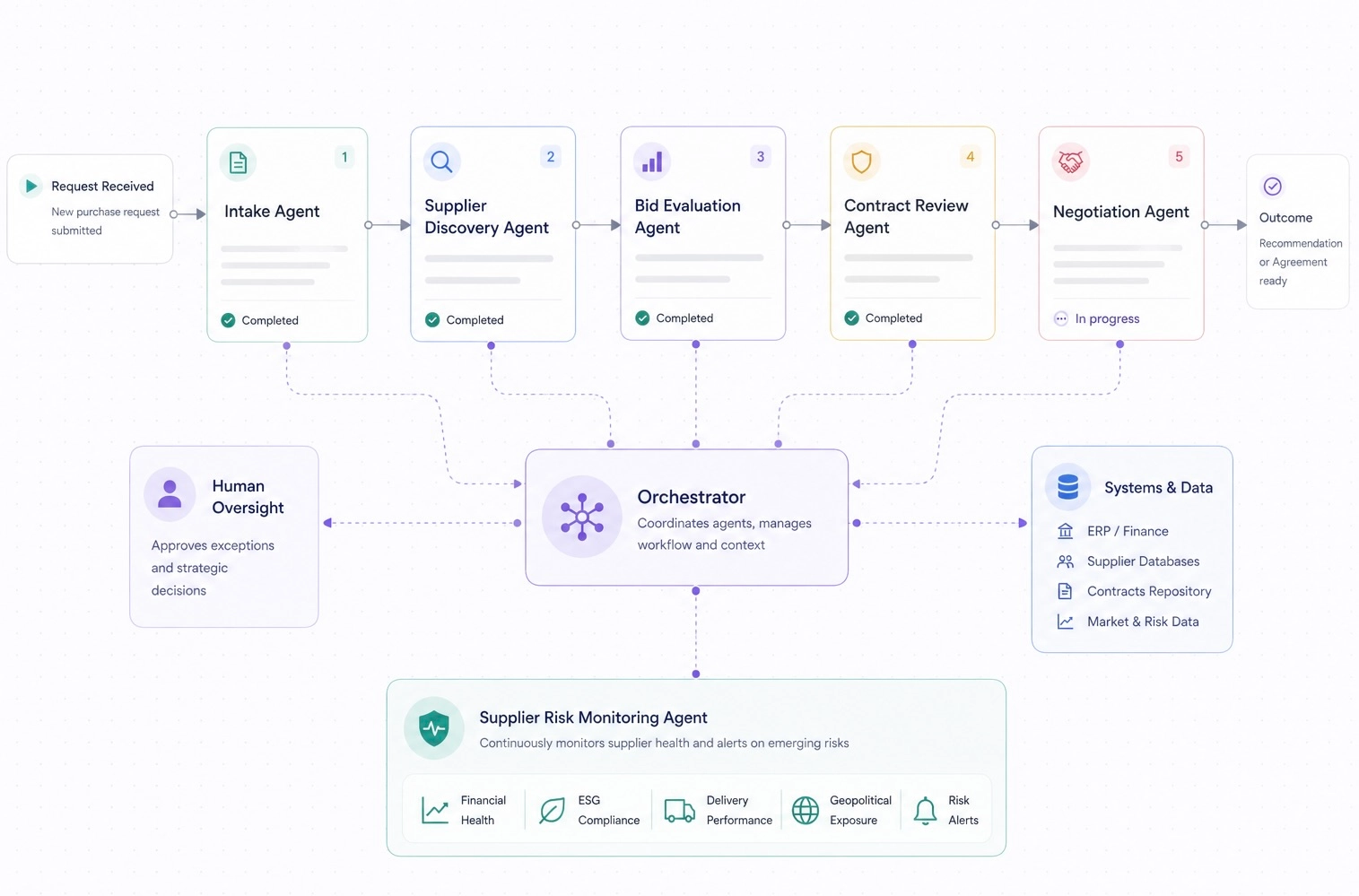
What makes this architecture durable is that as procurement requirements evolve across categories, markets, and regulatory obligations, new agents can be added without rebuilding the underlying system. The combined effect is procurement that handles parallel workstreams simultaneously, eliminates repetitive manual tasks across teams, and applies consistent evaluation criteria across every decision. No single tool can span this range. Autonomous AI agents can, because the work is distributed across agents built specifically for each domain, not stretched across one general-purpose system.
The efficiency gains are measurable and consistent across implementations. McKinsey estimates, that autonomous category agents alone capture 15–30% improvements through automation of non-value-added manual tasks, with measurable reductions in procurement cycle times. IBM Research projects 41% higher efficiency in source-to-pay processes and 49% improvement in touchless invoice processing by 2027 for organisations that deploy AI at scale across procurement.
Tail spend is where the gains arrive fastest. High-volume, low-value categories that rarely get strategic attention are exactly where automated management performs well: agents track spending against contracted terms, flag deviations, and surface negotiation opportunities without manual oversight. The result is savings in categories procurement teams previously had neither the time nor the data to actively manage.
Organisations running AI in procurement at scale accumulate something competitors cannot quickly copy: supplier intelligence, negotiation history, and risk data that supports more informed decisions with every interaction. Each sourcing event makes the next one better grounded. That is an advantage that takes time to build and does not transfer. The earlier an organisation starts, the more it compounds.
What these gains enable, cumulatively, is a shift in how procurement professionals spend their time. When agents handle the operational sequence, buyers can focus on the work that creates lasting business outcomes: category strategy, supplier development, and the negotiations where human judgment matters most.
Most failed AI implementations in procurement share the same root cause: data quality. 85% of executives cite it as their primary challenge, according to KPMG's AI Quarterly Pulse Survey. Agentic AI requires clean, structured, integrated data to function reliably. Disconnected systems, siloed supplier databases, and inconsistent categorisation produce unreliable agent outputs. A solid data basis is the prerequisite.
Cultural change is the second challenge that organisations underestimate. Procurement teams used to owning every step of the procurement process have to shift to overseeing agents that own the execution. That requires retraining and a different mindset: procurement professionals move from running the process to evaluating its outputs.
Governance needs to be defined before deployment, not after. Which decisions can agents make autonomously based on business rules? Which require human review? High-risk supplier decisions, major contract commitments, and anything touching sensitive regulatory areas belong in the human review category. Data security deserves parallel attention: broad AI access to procurement systems increases GDPR (General Data Protection Regulation) exposure, and data governance frameworks need to precede deployment.
The practical approach for most teams is to start with high-volume, lower-risk workflows. Invoice routing, supplier onboarding, and standard purchase requests are the right entry points. Build the architecture there before moving into strategic sourcing decisions.
Agentic procurement orchestration is not a future state. Intake automation, sourcing event management, bid analysis, and contract management are all running in production at enterprise customers today. The business case for agentic AI is clear: Gartner predicts that by 2028, 33% of enterprise software applications will include agentic AI, up from less than 1% in 2024.
What is still maturing is the depth of autonomous decision-making in complex, high-stakes scenarios. Strategic sourcing for critical categories, multi-year contracts with major suppliers, and cross-functional procurement decisions still require significant human involvement. That is how the governance model is designed to work, not a gap in capability.
Production-ready looks like this: agents handle operational execution, procurement teams make the strategic calls, and the platform makes every step visible. Most enterprise deployments start at proof-of-concept, where agents run alongside existing processes with humans validating every output before it counts, and reach production within six to twelve months.
Mercanis is an AI-native procurement platform with 55+ specialised AI Agents integrated natively across every module: sourcing, intake, contract management, and supplier relationship management. All agents work from a unified data basis across the platform, which means they share context, pass information without gaps, and build on each other's outputs rather than operating in isolation.
For organisations not yet ready for a full platform integration, Mercanis AI Agents can be deployed directly on top of existing ERP systems, including SAP S/4HANA and Oracle, as an entry point.
Human oversight is built in throughout. Governance rules define clearly when agents act autonomously and when procurement teams retain sign-off.
Explore how Mercanis implements agentic procurement orchestration →

Agentic procurement orchestration is the coordination of multiple specialised AI Agents that autonomously execute procurement tasks: supplier identification, RFQ creation, bid analysis, approval routing, and contract compliance monitoring. These agents operate in sequence and in real time, without requiring manual handoffs between steps.
Standard procurement automation is rule-based: fixed conditions trigger fixed actions. AI Agents are goal-oriented: given an objective, they determine how to achieve it and adapt as conditions change. An automated system sends a price alert. An AI Agent evaluates the price change in context, checks alternatives, and routes a recommendation without being prompted.
Purchase request validation, supplier identification, RFQ creation and distribution, bid scoring, approval routing, contract compliance monitoring, and supplier risk assessment are all in production use today. Complex strategic decisions, including major supplier commitments, high-value agreements, and category strategy, remain in the human review category.
Clean, structured, integrated data across procurement systems. This means standardised supplier master data, consistent product and service categorisation, and real-time data flows from ERP and SRM systems. Fragmented legacy data is the most common implementation blocker, and 85% of executives cite data quality as their primary AI implementation challenge.
Mercanis is an AI-native procurement platform with 55+ specialised AI Agents integrated natively across sourcing, intake, contract management, and supplier management. All agents share a unified data basis across the platform. For organisations not ready for full platform integration, agents can be connected directly to an existing ERP system as a first step. Governance rules define when agents act autonomously and when human sign-off is required for high-risk decisions.


Fabian Heinrich is the CEO and co-founder of Mercanis. Previously he co-founded and grew the procurement company Scoutbee to become a global market leader in scouting with offices in Europe and the USA and serving clients like Siemens, Audi, Unilever. With a Bachelor's degree and a Master's in Accounting and Finance from the University of St. Gallen, his career spans roles at Deloitte and Rocket Internet SE.