Small procurement teams are often faster, more precise, and more effective. Learn how standardization, automation, and AI can sustainably increase efficiency in procurement.
A small procurment team, a tight deadline, and yet everything runs smoothly. Decisions are made quickly, coordination is clear, and results are precise.
Through structured workflows, digital tools, and targeted process optimization, small procurement teams often achieve amazing performance gains.
A few months later, a larger team takes over the same process. Suddenly, there are more meetings, more emails, and less speed.
What sounds paradoxical is everyday practice: Small teams often deliver better results. They are more focused, make decisions faster, and waste less time in coordination loops.
This article explains why this is the case and how clear structures and automation enable this efficiency advantage.
More people, more power, more results – sounds logical, right?
In reality, the opposite is often true: with each new team member, not only does the potential grow, but so does the need for coordination.
What can be clarified in small teams with a quick call or chat message quickly turns into a chain of meetings, status updates, and queries in larger structures. The communication effort increases exponentially, while output increases only minimally. Labor costs rise, while the hoped-for increase in efficiency fails to materialize.
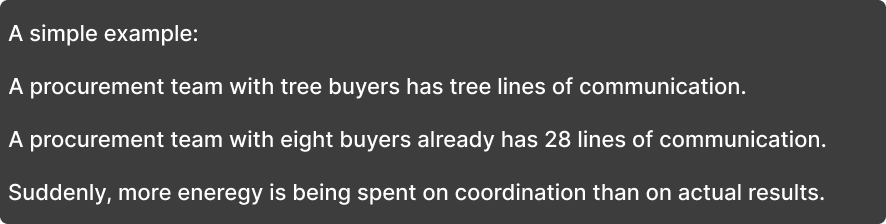
Scaling quickly becomes self-management.
Emails replace decisions, meetings become rituals. The team appears busy, but not productive. Transformation fails to materialize, and operational tasks dominate everyday life.
In large procurement organizations in particular, unclear processes and manual procedures cause additional delays. The effect is measurable: the larger the team, the more time is lost in internal coordination. Without clear structures, growth becomes a brake rather than an accelerator.
Our analysis of more than 40 procurement departments over a period of two years shows a clear pattern: Growth comes at the expense of speed.
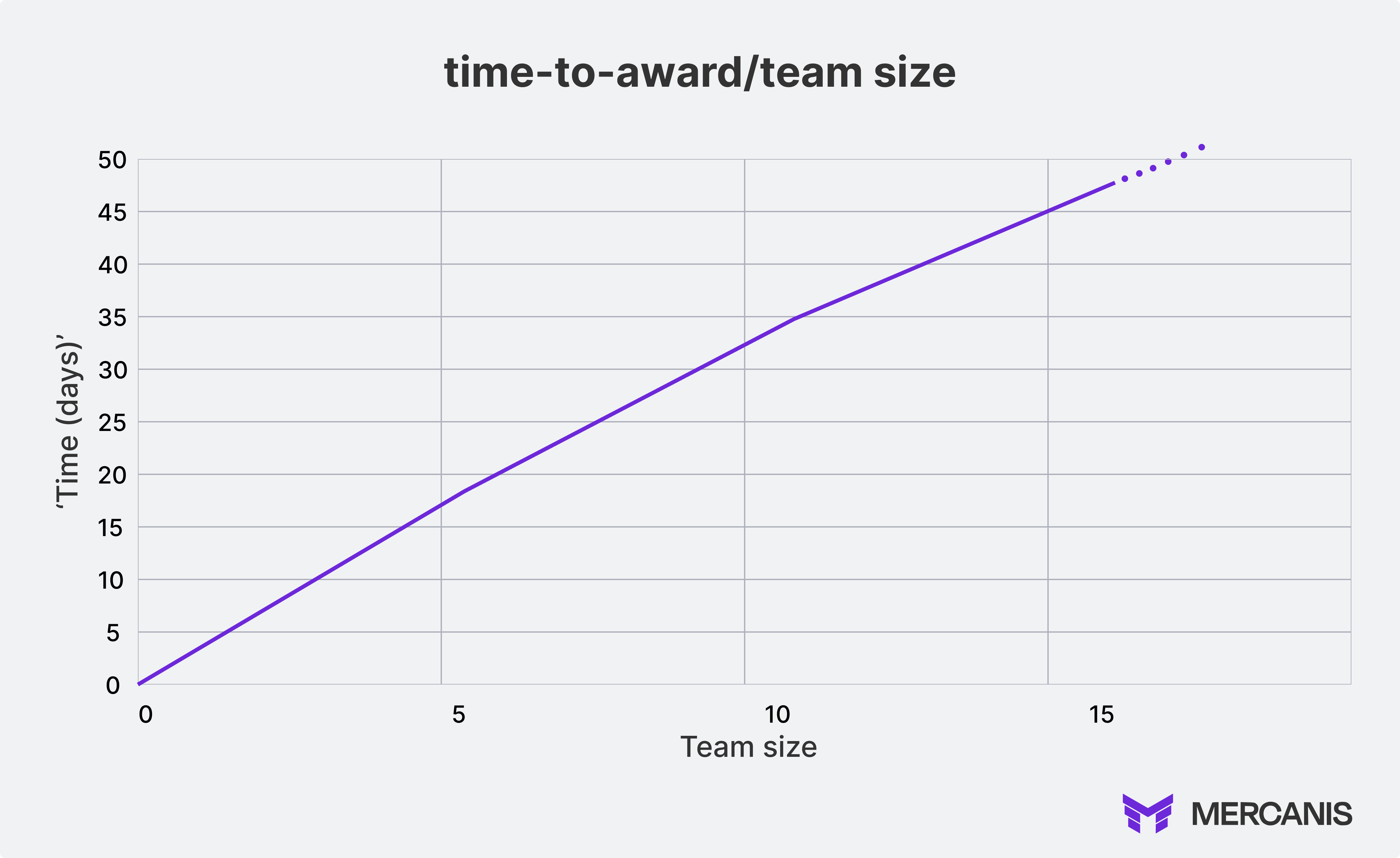
Small teams work on average up to 61% faster than large procurement departments – with comparable processes and similar volumes.
The reason is not competence, but complexity.
With each additional person, coordination processes become longer, decisions take longer, and information gets lost between tools, emails, and meetings.
The consequences are the same everywhere:
In short: complexity eats into speed.
And that's exactly what the figures show in black and white. Growth in procurement does not automatically lead to efficiency – but often to friction.
Increasing complexity in procurement not only slows down internal processes, but also jeopardizes the efficiency of the entire supply chain – and thus the competitiveness of the company.
Capacity is not the real problem; complexity is.
The first reflex in overloaded procurement departments is almost always: We need more capacity.
But additional staff do not solve a structural problem; they exacerbate it.
Each new person brings their own working methods, tool preferences, and supplier contacts. Different Excel formats, varying approval paths, or individually defined KPIs quickly lead to inconsistencies in daily operations. In particular, the lack of standardized supplier evaluation makes comparisons and decisions difficult and slows down procurement efficiency.
Instead of synergies, friction arises. Small deviations add up to major delays.
As the team grows, responsibilities also shift: decisions are delegated, queries go round in circles, and responsibilities become diluted.
The result: operational overload on the one hand, strategic paralysis on the other.
This dynamic quickly becomes an invisible cost trap, not only in the form of lost time, but also through quality defects.
Incorrect tenders, duplicate inquiries, or overloaded interfaces are typical symptoms of a system that uses more people instead of more structure.
Efficiency does not come from mass, but from methodology, clear processes, standardized tools, and traceable data flows.
Fast procurement teams are not a coincidence, but the result of consistent system work.
The secret to their success: they eliminate points of friction before they arise.
A four-person team with automated workflows, digital data access, and clear approval processes can achieve more than a twelve-person team that manually maintains information in Excel.
The targeted use of modern e-procurement solutions is a key lever here, as digital systems automate routines, create transparency, and keep the focus on what is essential.
Fast teams rely on transparency instead of control, on systems instead of silos.
They understand that speed is not created by pressure, but by clarity.
Successful procurement organizations rely on four principles that accelerate processes while promoting transparency, quality, and satisfaction within the team. Procurement strategies and strategic purchasing play a central role in this, as they enable the continuous development of efficient purchasing organizations and secure sustainable competitive advantages.
Modern technologies and advancing digitalization are also crucial for increasing efficiency in procurement, as they enable automation, transparency, and strategic process optimization.
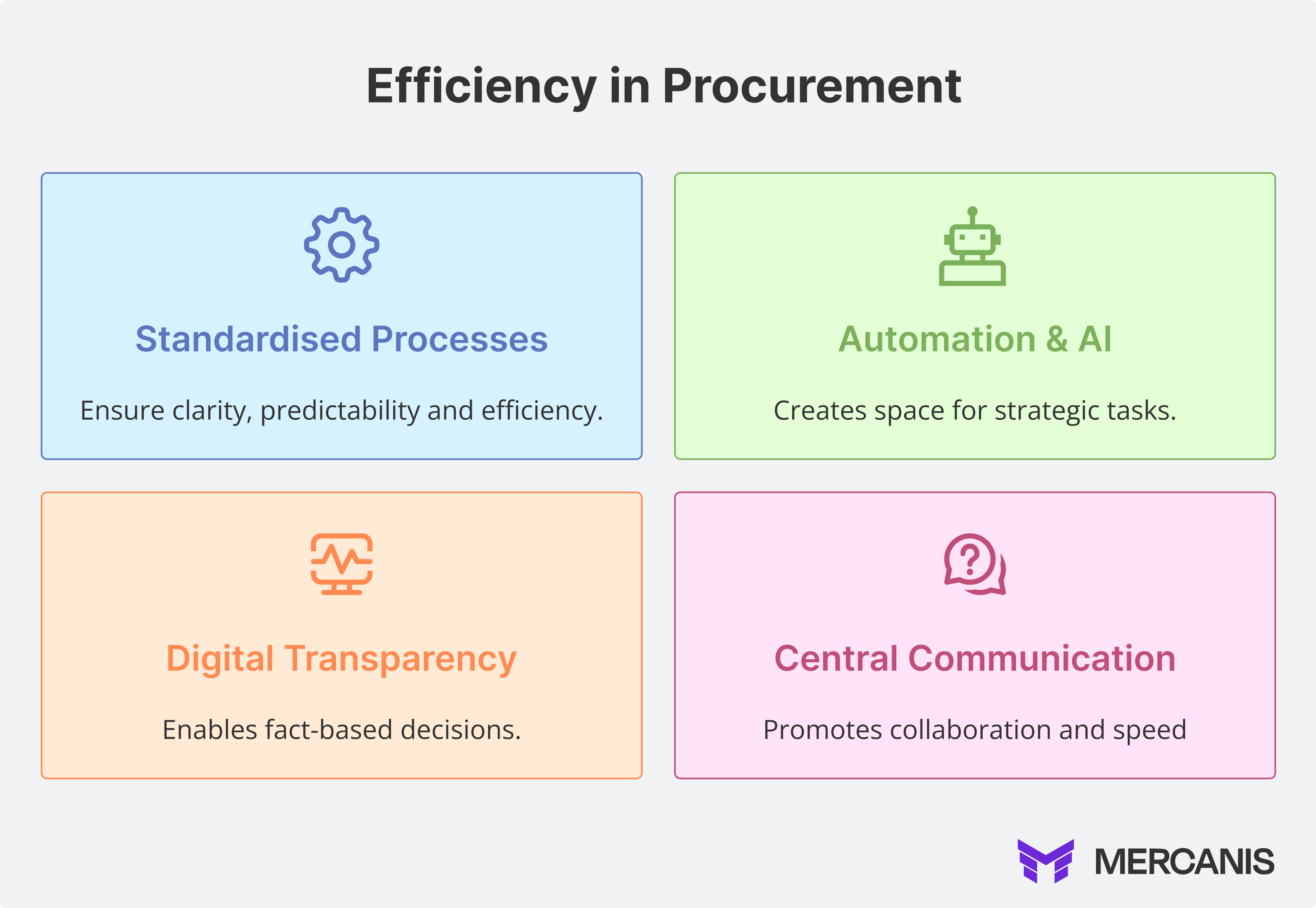
These are the backbone of any high-performance procurement organization.
Clear processes define who decides what and when, and prevent tasks from being duplicated or forgotten.
Standardizing the entire procurement process is crucial to ensuring efficiency and consistency in procurement.
Whether it's approval levels, supplier evaluations, or bid comparisons, standardization ensures clarity, predictability, and efficiency, even as the team grows.
Repetitive tasks such as requesting quotes, entering data, or sending supplier reminders are among the biggest time wasters.
E-procurement systems play a central role here by digitally mapping orders, approvals, and delivery tracking.
Automation saves teams valuable time that they can invest in strategic tasks such as negotiations, market analyses, or innovation projects.
This creates more impact with the same capacity.
Transparency is more than just data access – it is the basis for trust and responsibility.
A central dashboard with real-time insight into ongoing projects, budgets, or supplier performance prevents information gaps and enables fact-based decisions.
When everyone sees the same figures, guesswork disappears – and discussions turn into decisions.
Scattered emails, parallel chat histories, and unclear document versions slow down any organization.
A central location for communication and documentation – for example, in a procurement tool or collaboration system – ensures that everyone involved is on the same page.
This reduces misunderstandings, speeds up responses, and improves the quality of collaboration – both internally and externally.
The introduction of these four principles – standardization, automation, transparency, and centralized communication – is not a one-time project, but a structural change. It is crucial to proceed step by step and with clear priorities.
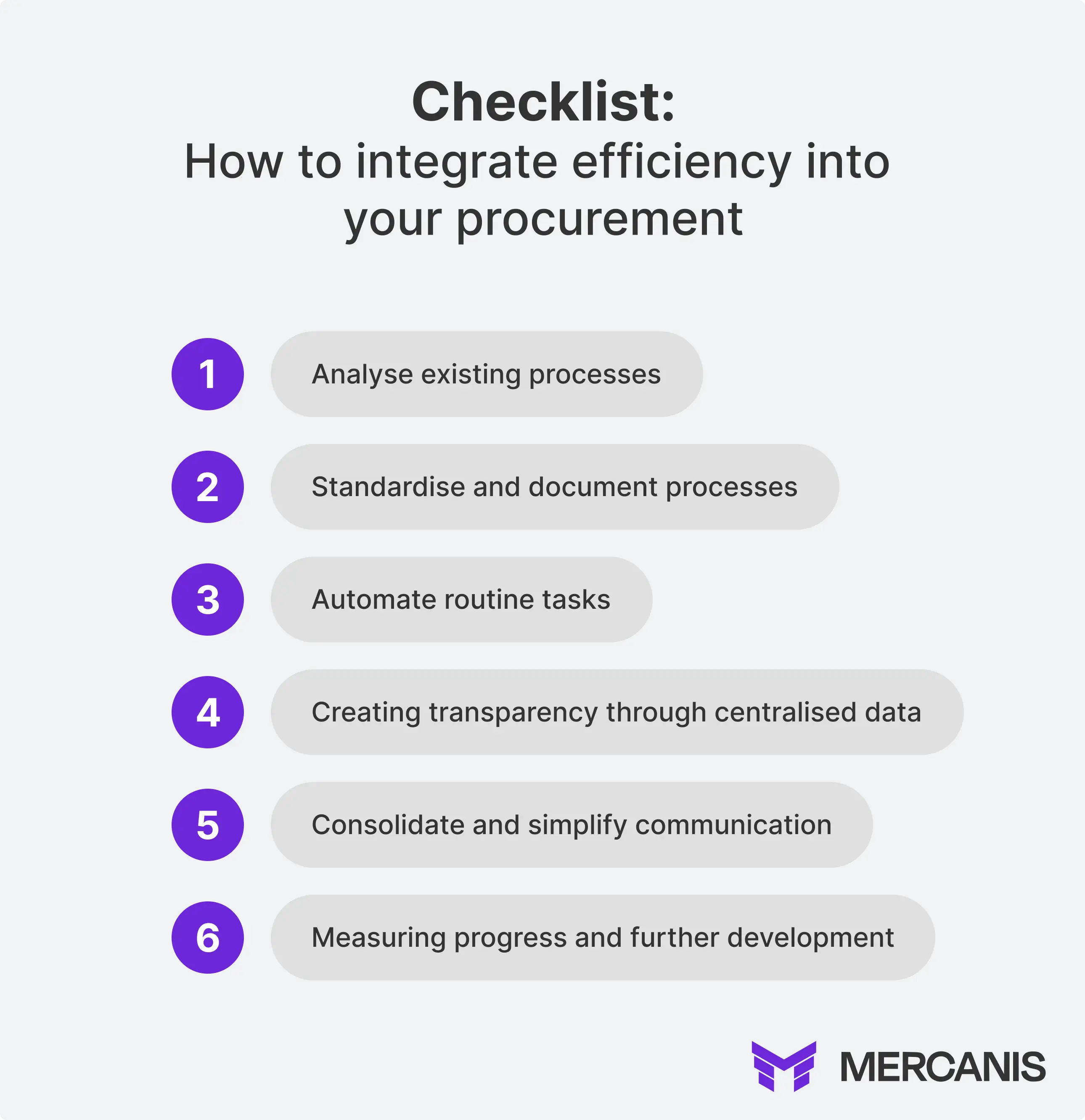
Before anything can be improved, it is necessary to identify where the problems lie. To do this, it is worth taking a critical look at the status quo.
Important topics in the analysis of existing processes include data quality, digitization, e-procurement, and market research, which offer key starting points for optimization.
Where do delays occur? Which tasks are repetitive? Where is information maintained twice?
This analysis forms the basis for simplifying processes in a targeted manner and defining clear responsibilities.
Create simple, understandable process templates, for example for approvals, bid comparisons, or supplier evaluations.
These standards should apply to all teams and be stored transparently, e.g., in an internal wiki or in the procurement system.
This ensures that everyone works according to the same rules, regardless of team size or location.
Identify regularly recurring tasks—such as quote requests, supplier reminders, or status updates—and automate them with digital workflows.
Digitalization plays a central role here, as it makes processes more efficient and transparent.
This reduces the workload for employees and frees up time for strategic activities such as market analysis, negotiations, or sustainability assessments.
Introduce a central dashboard or tool that bundles key figures, tenders, supplier evaluations, and project status.
This ensures that everyone has the same information and that decisions are traceable.
Transparency reduces misunderstandings and promotes trust. At the same time, it supports sustainable action, as environmental and social criteria can be better recorded and integrated into decisions.
Bring all coordination, documents, and messages together in one place—ideally in an integrated procurement or collaboration system.
This prevents information from being scattered across emails and chats and ensures that every team member is always up to date.
Efficiency is not a state, but a process.
Define clear KPIs – such as throughput time, time-to-award, or number of automated processes – and review them regularly.
Continuous measurement shows where the organization has already become faster and where there is further potential. This keeps development measurable and controllable.
Big data is revolutionizing procurement and opening up completely new opportunities for small teams in particular to optimize their processes.
By intelligently analyzing large amounts of data, buyers can identify trends early on, anticipate price developments, and specifically control their procurement behavior. This allows them to identify patterns in spending that indicate potential savings or areas for optimization.
Another advantage is that big data enables an objective assessment of supplier quality.
By evaluating performance data—such as delivery times, complaint rates, or price stability—teams can make informed decisions and select the best partners for their company. At the same time, procurement cycles can be shortened and costs reduced in the long term.
Integrating big data into the procurement process makes small teams more agile and gives them a real efficiency advantage.
They can react more quickly to market changes, identify risks at an early stage, and strengthen their competitiveness in a targeted manner.
This makes procurement a strategic lever for corporate success – regardless of team size.
In modern procurement, key figures and KPIs are indispensable for making the performance of the procurement department transparent and controllable.
They form the basis for objectively evaluating the efficiency of processes and improving them in a targeted manner.
The most important KPIs include the cost per order, savings through negotiations, supplier quality, and the OTIF rate (on-time, in-full), which indicates how reliable and complete deliveries are.
Regular analysis of these key figures allows weak points in the process to be identified at an early stage and targeted measures to be derived.
If, for example, the cost per order increases, this indicates where there is potential for automation. A decline in supplier quality, on the other hand, indicates a need for action in supplier management.
The return on investment (ROI) of procurement initiatives can also be clearly quantified in this way.
The consistent use of KPIs makes the success of the procurement strategy measurable – and enables the procurement department to be continuously developed.
This not only reduces costs and generates savings, but also sustainably increases the quality and reliability of procurement – a decisive contribution to the competitiveness of the entire company.
The way in which leadership is structured in procurement determines whether systems work or fail.
Even the best automation remains ineffective if it is not supported by a culture that promotes personal responsibility, trust, and openness.
Successful procurement managers see themselves not as controllers, but as enablers.
They create conditions in which teams can make decisions independently – based on data rather than hierarchies.
They set clear goals, prioritize strategically, and focus on impact rather than activity.
Modern leadership in procurement means replacing control with transparency.
When everyone knows what the team is working on, what goals apply, and what results count, there is less need for coordination – and more room for maneuver.
This creates speed without building pressure.
At the same time, communication is crucial:
Managers who provide regular feedback, identify obstacles early on, and make successes visible promote a climate of cooperation – not justification.
This allows small teams to remain agile even as their responsibilities grow.
And large teams learn to behave like small ones: clear, focused, and decisive.
Ultimately, efficient leadership is the catalyst for efficient structures.
It translates processes into action – and turns systems into results.
The procurement of the future is lean, digital, and focused.
In an age where speed, transparency, and data quality determine competitiveness, size is no longer an advantage – structure is.
The crucial question is therefore no longer: How many buyers do we need?
But rather: How much of our work can we systematize, automate, and standardize?
Because those who invest in processes rather than personnel today will secure a decisive efficiency advantage tomorrow.
With the advent of intelligent assistance systems, the role of procurement is changing fundamentally.
AI agents analyze supplier markets, identify risks early on, and prepare tenders – faster, more precisely, and more data-driven than ever before.
The digitization and automation of the entire procurement process is thus becoming a key factor for efficiency, transparency, and sustainable cost reduction.
This makes small teams even more agile: they make decisions based on insights rather than assumptions – and focus on what really matters – strategic control, partnership-based collaboration, and measurable value contribution.
The strength of humans lies not in processing tasks, but in making decisions.
And that is precisely where the future of procurement lies: less administration, more impact.



Fabian Heinrich is the CEO and co-founder of Mercanis. Previously he co-founded and grew the procurement company Scoutbee to become a global market leader in scouting with offices in Europe and the USA and serving clients like Siemens, Audi, Unilever. With a Bachelor's degree and a Master's in Accounting and Finance from the University of St. Gallen, his career spans roles at Deloitte and Rocket Internet SE.