2026 is the year of Agentic Procurement. What was still considered a future scenario in analyst reports and panel discussions just a year ago has arrived in day-to-day procurement. Autonomous AI agents execute operational process steps independently: demand capture, supplier qualification, offer evaluation, contract monitoring. The procurement professional sets the guardrails and makes the decisions that require judgment. Agentic Procurement describes this use of autonomous AI agents in operational procurement.
Procurement has been automated for the past two decades. What has shifted over that time is how much of the work the technology actually takes over. For a long time it stayed a supporting tool, speeding up individual tasks while still requiring the buyer at every point in the process. Agentic AI moves that line. For the first time, software executes whole process segments on its own and makes the in-between decisions that used to sit with the buyer on every iteration. The path into agentic procurement therefore starts with a look back at where today's automation hits its limits, and where agents work structurally differently.
Robotic Process Automation (RPA) emerged in the early 2000s: software that automates rule-based tasks by operating digital interfaces on its own. Blue Prism pioneered the category with "Automate," the first commercial RPA release, in 2003. A typical procurement use case was transferring data between systems that had no native interface, for example pulling supplier master data from onboarding forms into the ERP or creating recurring purchase orders automatically. Once an exception occurred or a format changed, it hit its limits. RPA could execute rules, not make decisions.
In the mid-2010s, the first procurement tools with machine learning capabilities entered the market. These systems brought predictive analytics into procurement: they recognized patterns in spend data, could forecast demand, and flagged supplier risks early. Decision-making and execution remained with procurement teams.
With ChatGPT from November 2022, the boundary shifted again. Large Language Models (LLMs) brought natural language processing into everyday use: software could understand and produce natural language, and so take over parts of execution. Tender drafts, contract summaries, and supplier communication were produced in minutes instead of hours. Leading procurement platforms integrated such generative AI capabilities in 2023, but generative AI remained reactive and executed only what the buyer instructed.
From 2024 onwards, agentic AI changed this fundamental logic. Gartner named it the most important strategic technology trend for 2025 in October 2024.
Unlike earlier AI systems, agentic AI does not wait for an input. Autonomous agents act independently within a framework that procurement teams have defined in advance. Decisions of strategic significance remain with the buyer.
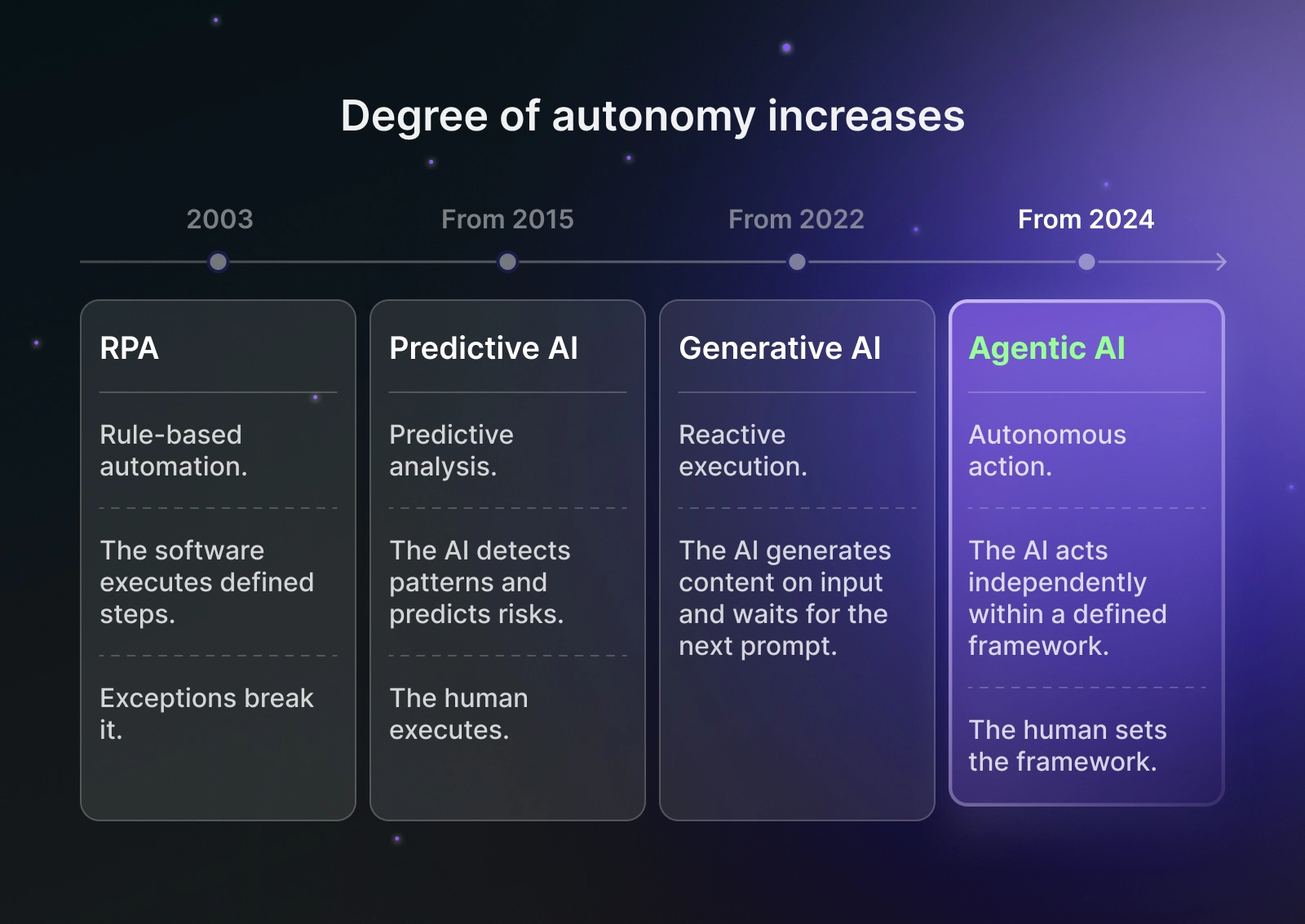
Each of the four technologies has a clear area of strength. Agentic AI in procurement combines them in a shared control layer and takes on tasks that none of the others can perform on their own:
The critical shift lies in two things: the human no longer has to trigger every single step, and multiple specialized AI agents work together in coordination. This multi-agent orchestration is the real innovation: specialized AI agents hand off tasks to one another, align on intermediate results, and defer to human oversight at defined thresholds.
Agentic procurement becomes clearest where AI agents actually steer a procurement process. The following sections show this along the core phases of a Source-to-Contract cycle (S2C), from demand capture to active contract, and beyond.
Every procurement process begins with a request: someone in the organization needs something. Until now that has meant emails, spreadsheets, and a buyer manually categorizing, checking, and routing every request. The Intake Agent is typically the first of the AI agents a procurement team deploys: it guides buyers and requesters through the procurement process in a structured way. It asks the right questions automatically, applies approval logic and sourcing rules, and routes fully structured requests directly into the matching workflow for sourcing, supplier management, or Procure-to-Pay (P2P).
The search for new suppliers has traditionally relied on manual database research and personal networks. Both approaches scale poorly across global supply chains. AI agents in supplier discovery close that gap.
Discovery Agents continuously search databases, commercial registers, and certification bodies, and they run structured qualification checks on creditworthiness, compliance, and ESG requirements. The result is a documented assessment that accelerates supplier onboarding and surfaces alternative suppliers for existing categories.
Tenders were traditionally tied to days of preparation: aligning specifications, selecting suppliers, sending out RFQs (RFQ = Request for Quotation), consolidating responses. Autonomous sourcing shifts this work to AI agents. This is one of the clearest examples of how AI transforms sourcing events. The Quick RFQ Agent handles the full cycle for requests to already approved suppliers, from briefing and dispatch through response consolidation. Within that cycle, a Negotiation Agent conducts follow-up negotiations by email, in assisted or autonomous mode, with the strategy and target price set by the buyer. For strategic sourcing with new suppliers, sourcing agents prepare the tender while the buyer retains the final call on supplier selection and award criteria.
Evaluating competing offers is especially error-prone under time pressure. Evaluation Agents normalize offers by price, delivery terms, quality, and compliance and produce a scored comparison on a total-cost basis, which makes supplier selection with agentic AI more consistent than manual scoring. The final award decision stays with the buyer, who can intervene at any step (human-in-the-loop).
Specialized contract AI agents cover contract lifecycle management from signature to renewal. Contract Extraction, Contract Review, and Contract Risk Agents read, compare, and assess contract clauses in seconds: they extract contractual obligations automatically and run contract compliance checks against defined standards. Beyond individual contracts, the same agents continuously monitor compliance with procurement regulations by tracking transactions and internal processes, and they alert the team to emerging compliance risks. Deviations from agreed terms are flagged for human review before they turn into disputes.
Beyond the S2C cycle, AI agents also take on continuous tasks: spend analytics and supply chain risk management. Market Intel Agents classify procurement data on an ongoing basis, track commodity prices, identify savings potential, surface tail spend that sits outside defined categories, and frequently trigger new sourcing events. In parallel, monitoring routines combine internal procurement data with external data such as financial reports, news feeds, and regulatory databases to evaluate risk factors. Supplier risk and supplier performance management run continuously against performance metrics, financial stability, and adherence to contractual obligations. When signals deteriorate, the agents flag the case and suggest corrective actions to strengthen the partnership before it breaks. Supply chain risk management becomes proactive: disruptions are identified before they hit production.
The Source-to-Contract cycle at a glance. Source-to-Contract (S2C) describes the framework for strategic procurement, from demand capture through supplier selection and award to active contract, distinct from Procure-to-Pay (P2P), which covers the operational handling from order to payment. In summary, a full autonomous S2C cycle runs through five stages that AI agents can steer independently today:
The performance gap between procurement operations using agentic AI and those that are not is measurable today. The evidence comes from independent research, not vendor case studies.
McKinsey's February 2026 analysis of procurement functions with agentic AI documents concrete case examples. In a chemical company that deployed AI agents in the consumables category, the procurement team achieved efficiency gains of 20 to 30 percent, combined with a value creation uplift of 1 to 3 percent. In a telecommunications company, AI-assisted negotiation support reduced the time spent on preparatory analysis and supplier emails by up to 90 percent while generating savings of 10 to 15 percent across suppliers. In pharma, AI agents that run invoice-to-contract compliance tracking reduced value leakage by four percent. Across the board, McKinsey estimates that procurement functions can become 25 to 40 percent more efficient through agentic AI.
The ROI data from Deloitte's Global CPO Survey 2025 tells the same story. Among the organizations Deloitte classifies as Digital Masters (the top quartile by technology investment and competence), the average return on investment for generative and agentic AI was 3.2x, compared to about 1.5x for organizations at earlier stages of adoption. Digital Masters earn back more than twice the return on the same AI spend, which means the gap between leaders and laggards is widening.
Behind these numbers lies a structural redistribution of capacity. When AI agents take on demand capture, tender preparation, offer evaluation, and compliance monitoring, procurement teams get time back that today goes into administrative tasks. That time then becomes available for category management, supplier innovation, and strategic risk management.
Organizations that achieve strong results with Agentic Procurement share certain prerequisites that make deployment possible in the first place. They deserve dedicated attention alongside the technology rollout itself.
Agentic AI is only as reliable as the procurement data it operates on. A Discovery Agent working with incomplete supplier data produces incomplete shortlists. A Market Intel Agent processing misclassified spend data delivers misleading insights. Gartner's Leadership Vision for CPOs 2025 shows that 74 percent of procurement leaders do not yet rate their data as ready for AI use at scale. The right response is to invest in data foundations first and to roll out AI agents in parallel on top of them.
Agentic AI systems take action. That means clear decisions must be made upfront about what they are allowed to do on their own, what requires human approval, and what must always stay with a human:
Organizations operating across multiple jurisdictions also need to define how their agentic AI systems handle company policies and data privacy standards that differ by country. Those that draw these boundaries before deployment build trust in their agentic AI systems incrementally, and they know where human oversight is mandatory by design.
Gartner predicted in June 2025 that more than 40 percent of all agentic AI projects will be canceled by the end of 2027. As the main reasons, Gartner cited rising costs, unclear value, and insufficient risk controls. What stands out: all three reasons come back to choices organizations make before rollout, not to limits of the technology itself. Organizations that put clarity on expected value and cost, early engagement of the business, and targeted capability building on equal footing with the technology from the outset avoid exactly the failure modes Gartner calls out, and they are among the organizations that realize the full performance leap from agentic AI.
Agentic procurement is open to any procurement organization willing to address three prerequisites on equal footing with the technology rollout: data quality, governance, and change management. These levers sit in the hands of procurement leaders. Those who prioritize them early realize the performance leap that agentic AI promises and are transforming procurement into a strategic function with a lead that is not quickly caught up.

Generative AI creates content based on an input: it formulates a tender, summarizes a contract, or produces a spend report when prompted. It is reactive and delivers output that a human processes further. Agentic AI goes further: it perceives its environment, pursues a goal, and executes multi-step tasks without waiting for an input at every step. In procurement, generative AI formulates a tender faster; agentic AI steers the entire sourcing process.
In productive deployments, AI agents reliably take on: demand capture and request routing, tender preparation and dispatch, offer normalization and scoring, supplier qualification checks against defined criteria, extraction of essential contract clauses, and spend classification. Tasks that require complex negotiation judgment, novel supplier relationships, or strategically far-reaching decisions remain with humans.
No. The evidence shows the opposite. Organizations deploying agentic AI do not reduce procurement headcount; they shift the work. When AI agents take on the transactional layer, procurement professionals move into areas that require human judgment: supplier relationships, category management, risk assessment, and internal stakeholder communication. McKinsey describes this shift as a move from execution to orchestration.
Three things are decisive. First, a solid data foundation: structured procurement data, complete supplier master data, accessible contract repositories. Second, defined governance: documented decisions about what AI agents may do autonomously, what requires human approval, and how exceptions are handled. Third, organizational readiness for a changed way of working, including training, clear communication, and a phased rollout that builds trust before the scope is expanded.
The answer depends less on the technology and more on the organization's maturity. The fastest path to value starts with quick wins: high-volume, rule-based, time-consuming tasks such as invoice matching or routine supplier follow-ups. Individual AI agents, such as an Intake Agent or a Quick RFQ Agent for already approved suppliers, can typically be deployed productively within a few weeks.


Fabian Heinrich is the CEO and co-founder of Mercanis. Previously he co-founded and grew the procurement company Scoutbee to become a global market leader in scouting with offices in Europe and the USA and serving clients like Siemens, Audi, Unilever. With a Bachelor's degree and a Master's in Accounting and Finance from the University of St. Gallen, his career spans roles at Deloitte and Rocket Internet SE.




.webp)