Supplier relationship management (SRM) is the strategic, systematic approach to managing a company's interactions with the suppliers that are critical to its operations. It focuses on fostering strong partnerships, optimising supplier performance, and ensuring effective communication to drive mutual benefits and enhance procurement efficiency. It encompasses various strategies to improve supplier interactions and data quality, going well beyond standard contract administration to build long-term relationships where the relationship itself creates measurable value for both parties.
Supplier management is the operational baseline: keeping vendor records current, managing purchase orders, renewing contracts, processing invoices. Every procurement function handles this as a matter of course.
SRM operates at a different level. Where supplier management keeps routine administration running, SRM builds commercial and operational value on top of that foundation. Performance development programmes, joint business reviews, co-innovation initiatives and shared risk management are SRM activities. The distinction matters for how procurement teams allocate time and what they measure as success.
Vendor management is typically applied to commodity or service suppliers where the relationship is defined primarily by contract terms and price. The interaction is managed to agreed standards, with the focus on compliance and cost control.
SRM implies a deeper investment in the relationship itself. It is used where cultivating a partnership yields returns beyond the contractual baseline: better pricing through open-book costing, earlier risk signals through regular dialogue, or access to new capabilities through joint development.
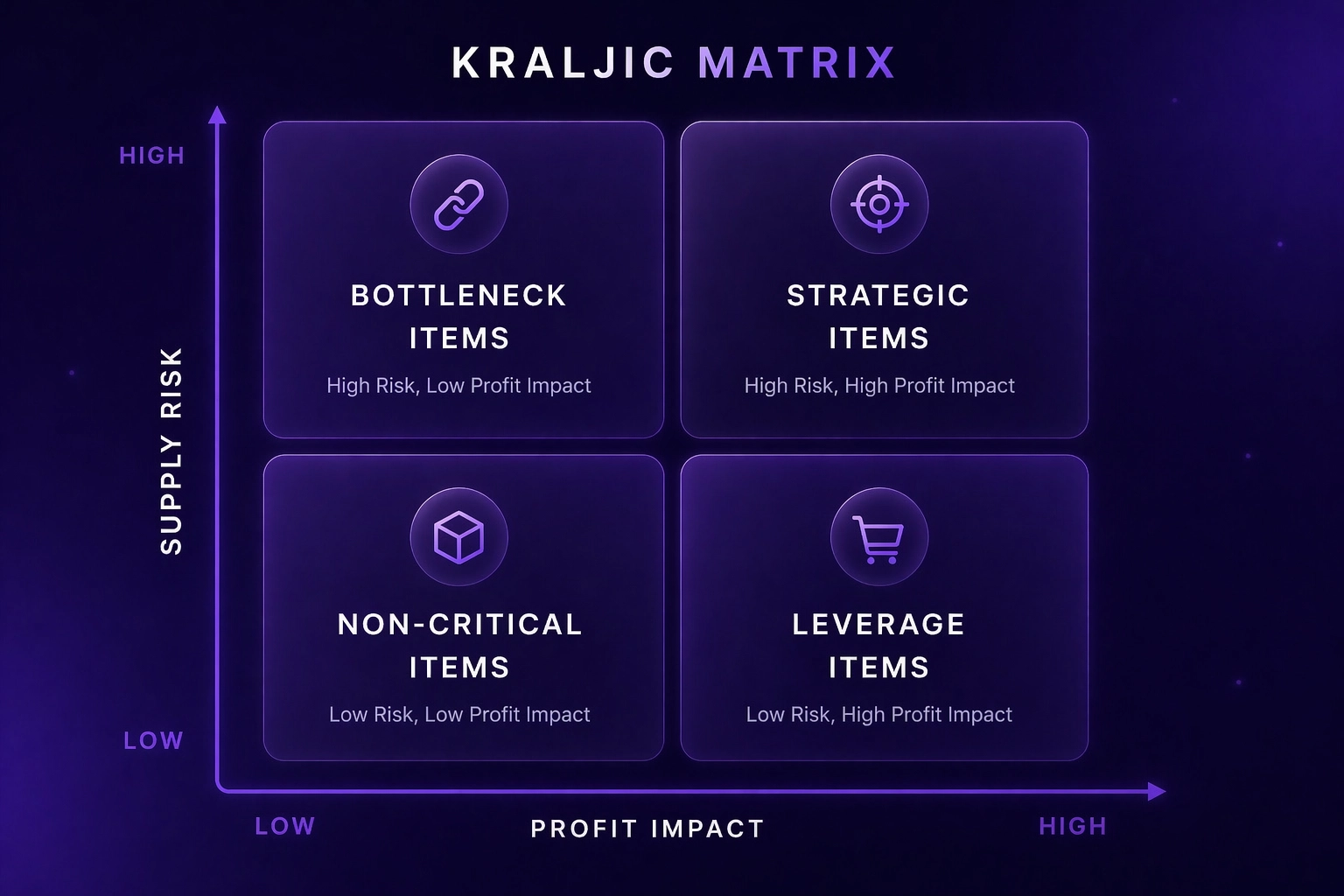
The analytical foundation for modern supplier relationship management was laid in 1983, when Peter Kraljic published his supplier portfolio model in the Harvard Business Review. The Kraljic Matrix organises a company's supplier base along two dimensions: supply risk and profit impact. Suppliers in the high-risk, high-impact quadrant require a fundamentally different management approach than commodity vendors with multiple readily available alternatives.
That framework established the core logic of supplier relationship management: differentiate how you manage suppliers based on their portfolio position, and invest relationship resources accordingly. Over the following decades, as global supply chains extended and supply chain disruptions multiplied, the concept evolved from an analytical tool into a full management discipline.
Strong supplier relationships create the conditions for better commercial outcomes. When buyers and suppliers share transparent cost data, joint optimisation becomes possible. A supplier with visibility into demand patterns can offer better pricing in exchange for forecast stability. A buyer with insight into a supplier's cost structure can identify where genuine efficiency savings exist on both sides. The result: measurable cost savings and a sustained ability to reduce costs across the supply base, not just at contract renewal.
Supplier relationship management provides the visibility and communication infrastructure to identify supply chain disruptions before they escalate. A supplier in an active SRM programme flags capacity constraints or financial stress earlier than one that only communicates at contract renewal. Strong supplier relationships also allow organisations to develop contingency plans proactively, giving priority access to materials or capacity when disruptions hit rather than scrambling to respond after the fact.
Suppliers carry process and materials knowledge that buying organisations often lack direct access to. Effective supplier relationship management creates the channels through which that knowledge flows into product development and process improvement. Collaborative partnerships between strategic suppliers and buyers lead to shared ideas, faster product development and competitive advantage. This is one of the clearest business cases for modern supplier relationship management: the ability to turn supplier knowledge into a strategic sourcing advantage. Joint innovation programmes, shared roadmaps and co-development agreements are all outputs of well-structured strategic supplier relationships.
Regulations including the German Supply Chain Due Diligence Act (LkSG) and the EU Corporate Sustainability Reporting Directive (CSRD) require organisations to monitor and document ESG performance across their supply chains on an ongoing basis. SRM provides the framework for collecting and verifying that data systematically, rather than through one-off audits that quickly become outdated. For more on how procurement teams approach this, see our guide to ESG compliance in procurement and supply chain due diligence.
The contrast between traditional supplier management and SRM is most visible in orientation: one is built around transactions, the other around value creation over time.
An effective supplier relationship management programme is built from five interconnected components. Together they define what good SRM practices look like in practice. They operate in parallel and reinforce each other over time.
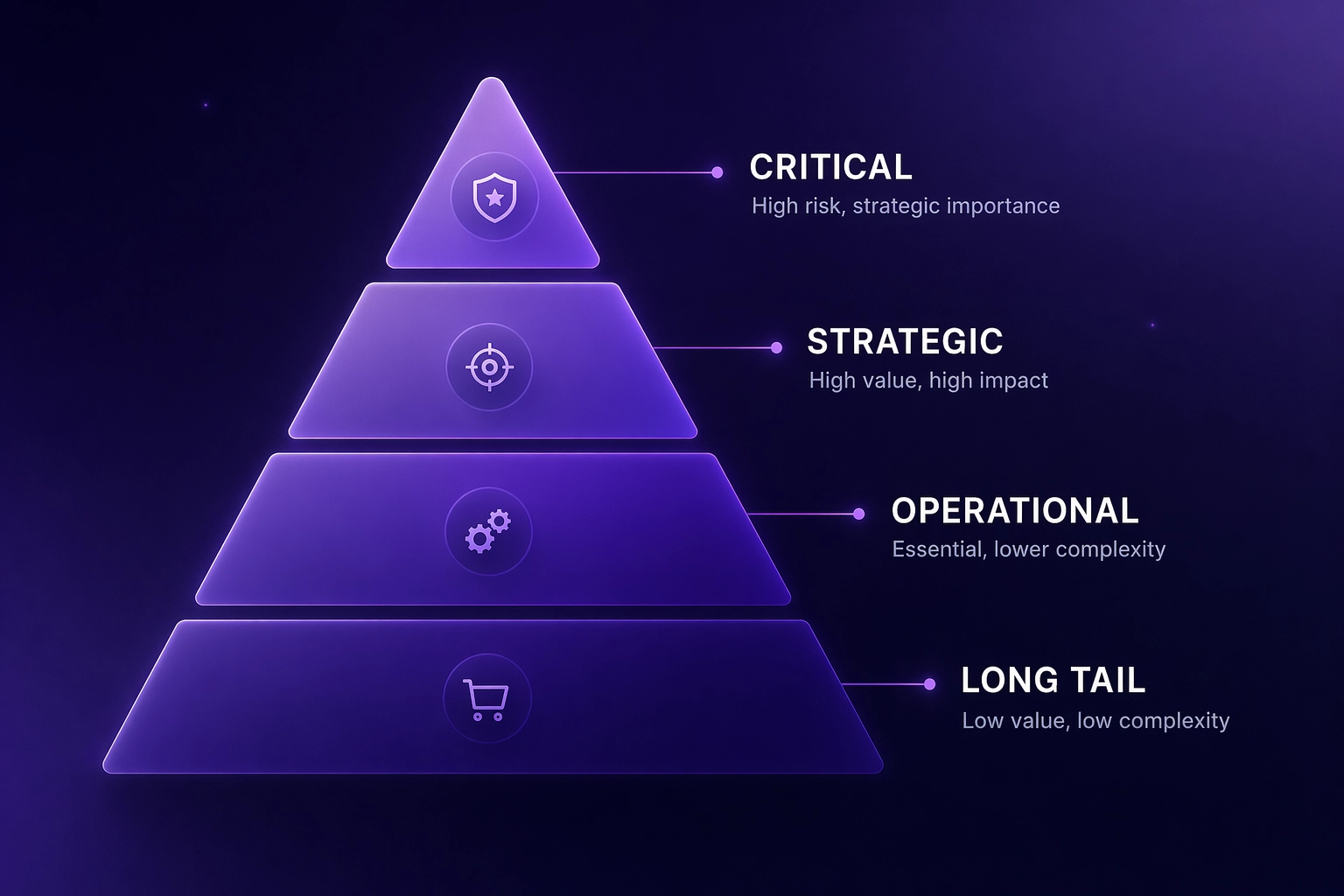
Segmentation is the starting point of any SRM programme. It divides the supplier base into tiers based on strategic importance, commercial impact and risk. Most organisations work with four. Critical suppliers carry high supply risk and high strategic importance: losing them or experiencing a disruption would directly threaten operations. Strategic suppliers drive high impact and high value, contributing to cost savings, innovation or competitive differentiation. Operational suppliers are managed through structured but lighter-touch processes. Long tail suppliers are handled primarily through automation and exception-based monitoring. The tier a supplier sits in determines the management approach, the frequency of reviews and how much relationship capital is invested.
Onboarding sets the quality of data and expectations from the outset. A structured qualification covers financial stability, quality certifications, compliance documentation and system integration requirements. Organisations that invest in this step carry fewer data problems into ongoing operations, have clearer grounds for supplier performance conversations later and lay the foundation for effective supplier collaboration from day one.
Tracking supplier performance against agreed performance metrics is central to SRM. The most widely used metrics in supplier performance management are on-time in full delivery (OTIF) and product quality rejection rates. Programmes also track lead time reliability, contract compliance and, at the strategic tier, innovation contribution and sustainability performance. Regular performance reviews ensure suppliers consistently meet high-quality standards and highlight where supplier performance needs to improve. Supplier scorecards should be shared openly: visibility into how key suppliers are performing creates accountability and gives them the information they need to act.
Compliance management means actively monitoring whether contractual terms are being met across the supplier base, not storing documents and revisiting them at renewal. SRM programmes track SLA adherence, certification expiry and regulatory requirements as ongoing activities, with automated alerts when thresholds are breached.
At the strategic tier, SRM creates structured space for process improvement initiatives and supplier collaboration, ranging from logistics optimisation to co-development of new materials or processes. Building collaborative relationships with key suppliers enables both parties to benefit from shared knowledge and reduce costs through joint efficiency gains. This is what distinguishes SRM programmes that deliver sustained value from those that remain transactional. The prerequisite is mutual transparency, which takes time to build.
The supplier relationship management process operates as an ongoing management cycle, not a one-time setup. Effective SRM practices require organisations to continuously manage supplier relationships across all tiers. Good supplier relationship management strategies are only as strong as the processes that support them. These five steps describe how procurement leaders run a structured SRM programme over time.
Map your supplier base against commercial impact and supply risk. Identify which suppliers fall into the strategic tier, which are tactical and which are transactional. This segmentation determines who receives dedicated relationship owners, who is reviewed quarterly and who is managed through automated monitoring.
Different tiers require different performance frameworks. Strategic suppliers need a broad scorecard covering innovation, sustainability and collaboration alongside delivery and quality metrics. Tactical suppliers need a tighter set of operational KPIs. SLAs should be reviewed with suppliers before they go live. A supplier that has agreed to the framework at the outset is more likely to engage with it meaningfully.
For strategic suppliers, a quarterly business review at senior level is the standard cadence, supplemented by more frequent operational contact. For tactical suppliers, semi-annual reviews are often sufficient. For transactional suppliers, automated exception-based alerts are the right model: only escalate when something falls outside agreed parameters.
Continuous monitoring replaces the traditional approach of reviewing performance only at contract renewal. Data on delivery, quality, compliance and supplier risk should flow into a central system in real time, giving procurement teams visibility of emerging issues before they require formal escalation.
Periodic reviews at the strategic tier should include a forward-looking component: where can both parties create additional value? Joint improvement plans and co-innovation initiatives are the typical outputs. For all tiers, the review should also assess whether the original segmentation classification still holds.
The most common reason SRM programmes underperform is the absence of a strategy. Teams collect supplier data, run occasional reviews and call it SRM. Without clarity on which suppliers are strategic, what outcomes the programme should deliver and how success will be measured, the activity has no direction. Deloitte's Global CPO Survey found that 80 to 85 percent of companies planned to enhance their SRM capabilities. The gap between ambition and execution is almost always a strategy problem.
Supplier data sits in ERP systems, spreadsheets, contract repositories and email inboxes. Without a centralised platform, maintaining an accurate view of supplier performance, risk exposure and commercial terms across any meaningful supplier base is not feasible. Data quality problems compound quickly: a supplier that appears compliant in one system may have open quality issues tracked in another.
Supplier relationship management requires active collaboration across procurement, quality, finance, operations and legal. Getting cross-functional alignment on objectives and KPI definitions is consistently cited as one of the hardest implementation challenges, particularly in organisations where procurement has historically operated in isolation.
Strategic SRM asks suppliers to share cost breakdowns, capacity plans and risk indicators. Many are reluctant to, particularly when the relationship has historically been adversarial. Trust is built over time. Buyers need to demonstrate that information will be used to improve the partnership before suppliers will provide it.
Without a structured programme, supplier reviews depend on individual relationship owners applying different standards. The result is a supplier base that cannot be compared at a portfolio level, and limited visibility into which relationships are healthy until a crisis surfaces the problem.
Supplier relationship management software improves access to performance data by bringing it into one interface, in place of relying on a complex enterprise resource planning (ERP) system where supplier data is stored across multiple places and is difficult to access. It offers a toolkit for the complete supplier lifecycle, from onboarding and qualification through to performance tracking, contract management and supplier scorecards.
Advanced platforms add predictive analytics, identifying trends in performance data before they become operational problems. A supplier whose on-time delivery has been declining gradually across several quarters will appear in a trend analysis well before a single missed shipment triggers escalation.
AI agents are increasingly used to automate routine tasks in supplier management, freeing up procurement teams for higher-value work. For a closer look at how AI is changing day-to-day supplier relationship management, see our article on AI-powered supplier relationship management and supply chain resilience.
"Enhancing supplier relationship management and strategic partnerships tops the list of high strategic priorities for CPOs at 55% - ahead of AI-driven automation and strategic sourcing." - 2026 Annual ProcureCon CPO Report
Mercanis supports enterprise procurement teams across the full SRM cycle, from supplier segmentation and onboarding through to performance management and compliance monitoring.
See how Mercanis brings SRM to life for enterprise procurement teams →

Supplier relationship management (SRM) is the strategic, systematic approach to managing interactions with suppliers that are critical to an organisation's operations. It goes beyond contract administration to cover supplier segmentation, performance monitoring, risk management and long-term partnership development with the suppliers where the relationship itself creates measurable value.
he five key components are supplier segmentation, supplier onboarding and qualification, performance management and KPIs, contract and compliance management, and continuous improvement and collaboration. Segmentation categorises suppliers by strategic importance and risk. Onboarding assesses and integrates new suppliers against defined standards. Performance management covers metrics such as OTIF, quality rates and compliance. Contract management monitors contractual obligations and regulatory requirements. Continuous improvement covers joint programmes to reduce waste and develop new capabilities.
Supply chain management (SCM) covers the full flow of goods, information and finances from raw material to end customer: production, logistics, distribution and returns. SRM is a specific component within SCM, focused on the buyer-supplier interface. SCM addresses the entire supply chain network and SRM addresses the quality of the relationships at the sourcing end of it.
The five pillars are: plan (demand planning and supply chain strategy), source (procurement and supplier management), make (production and manufacturing), deliver (logistics, distribution and order fulfilment) and return (reverse logistics and after-sales service). This framework comes from the Supply Chain Operations Reference model (SCOR). SRM sits primarily within the source pillar.
Supplier Lifecycle Management (SLM) is a comprehensive approach that integrates with SRM processes to manage suppliers effectively at every stage of their lifecycle. SLM ensures that all aspects of supplier interactions are optimised, from initial engagement to performance evaluation, aiding in the achievement of long-term strategic goals.


Fabian Heinrich is the CEO and co-founder of Mercanis. Previously he co-founded and grew the procurement company Scoutbee to become a global market leader in scouting with offices in Europe and the USA and serving clients like Siemens, Audi, Unilever. With a Bachelor's degree and a Master's in Accounting and Finance from the University of St. Gallen, his career spans roles at Deloitte and Rocket Internet SE.