- For Suppliers
- Login


Procurement teams regularly face the same question: which document is the right one and when? RFI, RFQ and RFP are often used interchangeably in practice, even though they serve fundamentally different purposes. The wrong choice costs time: suppliers deliver the wrong responses, requirements need to be clarified after the fact, and processes slow down. What distinguishes RFI vs. RFQ vs. RFP, when each one applies, and how AI is already changing RFX processes today is what this overview addresses.
RFI, RFQ and RFP are the three core request documents in the sourcing process. Each serves a different purpose and comes into play at different stages of the procurement process. Choosing the right document determines what information you receive from suppliers and how efficiently the process runs.
A Request for Information (RFI) is a formal, non-binding document used by procurement teams to gather information about potential suppliers and their capabilities. It sits at the very beginning of the sourcing process and serves purely as an orientation tool: Which suppliers exist? What can they deliver? What price ranges are realistic? An RFI commits neither the buyer nor the supplier to any specific deliverable. It is a structured instrument for market analysis, used before concrete requirements have been defined.
The RFI comes into play when the procurement team does not yet have enough information to launch a formal tender. Often, the goal is simply to get an overview of the market, particularly when a team is entering a new category and does not yet know which suppliers exist, what solutions are available, or what price ranges are realistic. In regulated industries, there is an additional reason: compliance requirements frequently mandate documented market analysis before a formal tender can be launched.
The RFI is equally useful when internal requirements have not yet been finalised. Supplier feedback helps create clarity and develop a well-founded definition of need.
A Request for Quotation (RFQ) is a formal procurement document used to obtain price quotes for clearly defined goods or services. Specifications, quantities and requirements are fully fixed at this point. The document is sent exclusively to pre-qualified suppliers. The RFQ is used when the procurement team knows exactly what it needs and the decision is driven primarily by price. This is typically the case for standardised, comparable goods: raw materials, spare parts, hardware, office supplies, or recurring services such as maintenance contracts. It is equally appropriate when expanding an existing system, for example, when a company wants to procure 200 additional units of a machine part already in use. In such cases, specifications and the supplier pool are already known, and price is the only open question. The fundamental requirement is that specifications are defined precisely enough for all suppliers to quote on the same basis, enabling direct comparison. No supplier should be expected to interpret requirements or propose their own solution, that is neither desired nor productive in an RFQ.
A Request for Proposal (RFP) is a formal procurement document used to collect comprehensive proposals for complex requirements. Unlike the RFQ, price alone is not the primary focus: suppliers are asked to submit a complete solution proposal that covers not only pricing but also methodology, implementation plan, qualifications and risk mitigation. The decision is made based on multiple weighted criteria.
The RFP is used when requirements are known but the solution is still open. This is particularly the case for complex services or projects where different suppliers may pursue different approaches, such as IT implementations, consulting engagements or strategic supplier partnerships. For high-value or high-risk purchases where a purely price-based decision is insufficient, the RFP is also the right instrument. In many public institutions and regulated industries such as pharma or energy, the RFP is legally mandated. Procurement regulations require formal tendering procedures with documented evaluation above certain contract values. The RFP provides exactly this documentation, making it transparent why a particular supplier was selected based on which criteria.
Which document is right depends on how well the procurement team already understands the requirements and the market. When requirements are still unclear, the RFI is the logical starting point. When they are defined and the only remaining question is finding the best price, the RFQ is the right tool. When the decision is more complex and factors beyond price, such as methodology, quality or implementation approach, also matter, the RFP is the right instrument.
In practice, the three documents often follow a specific sequence:
RFI → RFP → RFQ
First the RFI for market analysis, then the RFP to evaluate proposed solutions, and finally the RFQ for the final price comparison. That does not mean all three always need to be used. Teams that already know the market well and have clear requirements can go straight to an RFP or RFQ.
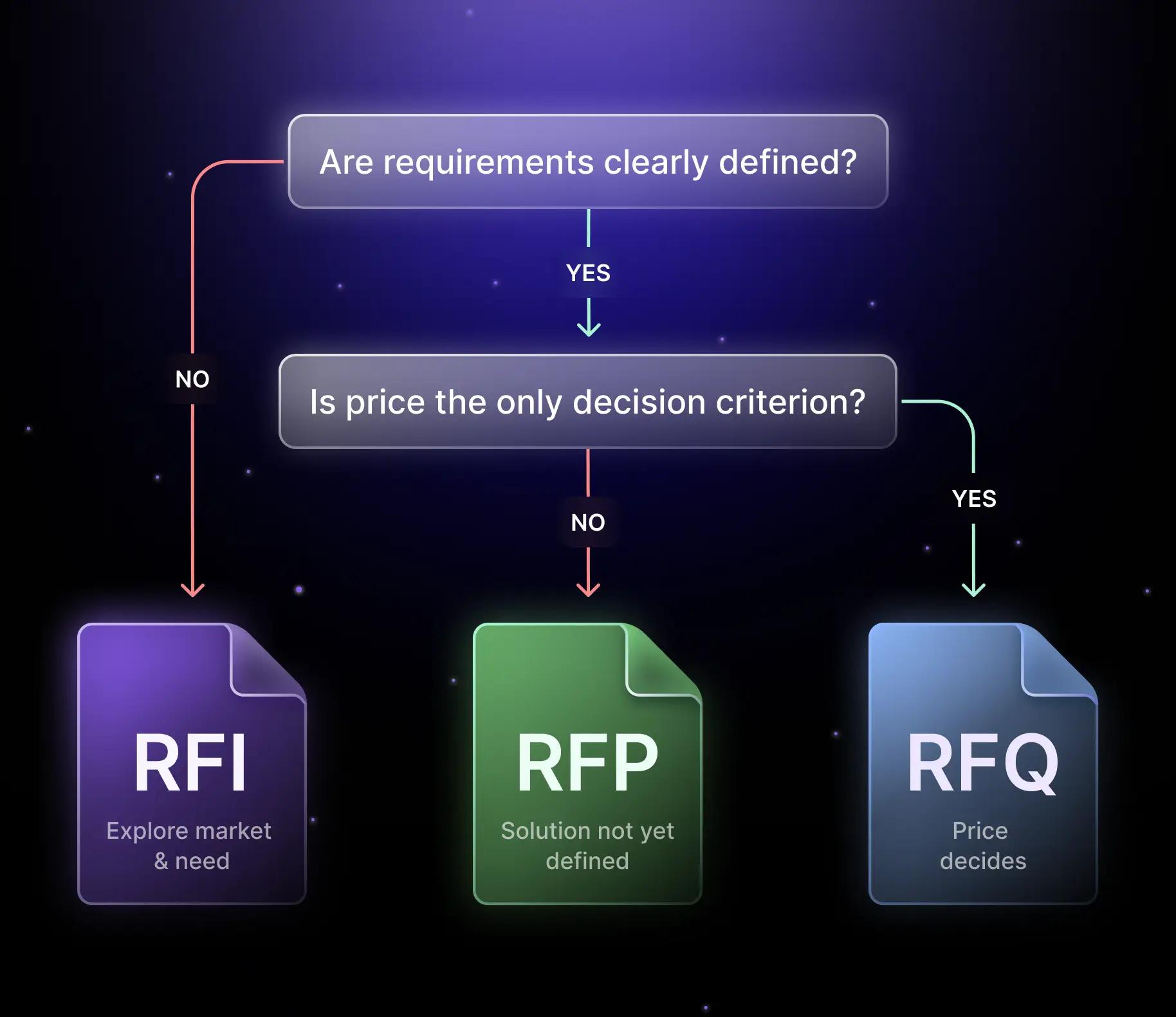
Mislabelling documents. In practice, "RFP" is often used as an umbrella term for all three documents, simply because it is the most formal and widely recognised. This leads to suppliers delivering the wrong type of response because they do not know whether they are expected to submit a solution proposal, a price quote, or information about their capabilities. The better approach is to clarify internally before sending, what is the purpose of this document, and what kind of response do you need from suppliers and then choose deliberately between RFI, RFQ and RFP on that basis.
Skipping the RFI. Going straight to an RFP or RFQ for a new or complex category risks entering the market with unclear requirements. The result is suppliers who do not fit the need but respond anyway, and a process that bogs down in follow-up questions and corrections. Teams entering unfamiliar categories are better served by starting with an RFI to build solid market understanding before moving into supplier selection.
Issuing complex purchases as an RFQ. An RFQ signals to suppliers that no independent solution approach is expected. Issuing a complex project as an RFQ results in prices rather than creative proposals, for a solution that may not optimally address the actual need. The RFP is the right instrument whenever methodology, quality or implementation approach matters as much as or more than price.
Starting the RFQ too early. An RFQ requires that specifications, quantities and delivery criteria are defined precisely enough for all suppliers to calculate on exactly the same basis. Failing to ensure this produces quotes that cannot be compared directly, one supplier calculates with different quantities, another applies different quality standards. The result is proposals built on different assumptions that cannot be meaningfully evaluated side by side. Before launching an RFQ, it is worth checking whether specifications need further internal development, or whether an RFI could first create more clarity.
Despite their strategic importance, RFI, RFQ and RFP are still handled manually in many organisations. Many procurement teams rely on email, Word documents and spreadsheets, which generates elevated error rates. A frequently underestimated factor is also the supplier experience: the more complex and unclear request documents are, the lower the response rate and the weaker the quality of submissions, as suppliers shy away from the effort or provide incomplete information. This creates a cycle: procurement teams spend more time chasing incomplete responses, processes slow down, and requests have to be resent. The consequences are measurable 20 percent of all RFPs are never completed, and organisations now respond to only 55 percent of incoming requests.
New technologies are already changing how procurement teams handle RFI, RFQ and RFP. 42 percent of procurement organisations are already using AI to create RFP and RFQ documents, the most widely adopted use case after spend analytics (Deloitte, 2025). Modern platforms are already making RFx processes more efficient and improving the user experience: on the procurement side, workflows are structured and easier to navigate; on the supplier side, interfaces are designed to make filling in proposals significantly less burdensome.
What this means in practice is illustrated by the Franz Morat Group, a family-owned precision engineering manufacturer with around 650 employees and 600 to 800 active suppliers. Previously, RFQs were managed entirely via email threads, bid comparisons were done manually in Excel, and buyers spent around 30 minutes per RFQ on price analysis alone. Historical price trends had to be painstakingly reconstructed from old files, and knowledge of process status was held by individuals rather than systems. Today, RFQs are created in structured formats, suppliers respond digitally, and bids are automatically normalised and directly comparable. Price analysis takes 2 minutes instead of 30. The status of every tender is immediately visible without manual tracking.
Another step already in productive use today is agent-based workflows. What this looks like in practice is best illustrated by the Quick RFQ: the buyer describes the requirement via prompt, selects suppliers, and sets the negotiation strategy, for example fixed prices with flexible payment terms. Specialised AI agents then take over the operational work: they contact suppliers by email, collect bids, negotiate automatically across multiple rounds, and present results in a dashboard. This is particularly relevant for technical spend, C-parts and smaller services, where manual negotiation is simply too resource-intensive relative to the contract value. The goal is to automate operational negotiation work and capture savings across a large number of small RFQs without permanently tying up buyers.
The transition from manual RFX processes to AI-supported ones does not happen in a single step. Not all procurement organisations are at the same stage, and RFI, RFQ and RFP often progress at different speeds.
Automated creation of RFI, RFQ and RFP from templates and historical tender data will become the standard. McKinsey has already developed an RFP engine that replicates complex analyses in a fraction of the previous time based on over 10,000 cleaned tender templates, identifies gaps in tenders and structurally optimises future RFPs. For standardised categories, self-executing RFx processes are expected to become routine according to Art of Procurement. By 2028, AI agents could handle between 60 and 70 percent of transactional procurement, including standardised tenders and continuous supplier monitoring (SupplyChainBrain, 2026).
When introducing AI into RFX processes, it is useful to separate two distinct questions. The first is implementation: according to BCG, success depends 70 percent on people, processes and culture , not on the technology. This applies to every technological change introduced into procurement. Underestimating this leads to failure not because of the technology, but because of the organisation itself. Change must be carried by the people who work with these processes every day, not just introduced, but genuinely adopted.
The second is the question of the goal: fully autonomous procurement across all categories is not the only benchmark against which AI in procurement should be measured. Applied to RFI, RFQ and RFP, this means: selecting the right supplier in an RFP, setting negotiation strategy in an RFQ, making strategic sense of market intelligence gathered through an RFI, these are decisions that require human judgement. AI handles the operational part, freeing up capacity for exactly these tasks. The important decisions stay with people.
And that should also be the goal: more efficient processes that give procurement more room for strategic work.
Organisations that use RFI, RFQ and RFP according to their actual needs make better decisions, receive more comparable bids and save time. Technology reduces manual effort, improves the user experience and makes RFX processes more scalable and efficient.
.avif)

RFI, RFQ and RFP are three different request documents in procurement, each serving a distinct purpose. An RFI (Request for Information) is used for market analysis and is non-binding. An RFQ (Request for Quotation) collects price quotes for clearly defined goods or services. An RFP (Request for Proposal) solicits comprehensive solution proposals for complex requirements. The key difference lies in the objective: the RFI informs, the RFQ compares prices, the RFP evaluates overall solutions.
In practice, the three documents often follow the sequence RFI → RFP → RFQ. First the RFI for market analysis, then the RFP to evaluate proposed solutions, and finally the RFQ for the final price comparison. Not every procurement requires all three steps. Teams that already know the market well and have clear requirements can go straight to an RFP or RFQ.
Yes, that is possible, but not always advisable. The RFI is particularly important when a procurement team is entering a new category or requirements have not yet been finalised. Skipping the RFI in unfamiliar categories risks going to market with unclear requirements and engaging suppliers who do not match the need. When the market and requirements are already well understood, moving directly to an RFP or RFQ is perfectly appropriate.
RFX is an umbrella term for all "Request for" documents in procurement. The "X" acts as a placeholder for the specific document type: RFI (Information), RFQ (Quotation) or RFP (Proposal). The term is used when referring to tendering processes in general, without specifying a particular document type.
No. For simple, standardised purchases, an RFQ is often sufficient. Teams that already know the market well and have clear requirements can also start directly with an RFP. Using all three documents in sequence only makes sense when the market is unfamiliar, requirements are still unclear, and the procurement is complex enough to justify a multi-stage evaluation.


Fabian Heinrich is the CEO and co-founder of Mercanis. Previously he co-founded and grew the procurement company Scoutbee to become a global market leader in scouting with offices in Europe and the USA and serving clients like Siemens, Audi, Unilever. With a Bachelor's degree and a Master's in Accounting and Finance from the University of St. Gallen, his career spans roles at Deloitte and Rocket Internet SE.