Most procurement teams have a structured process for buying laptops. Few have one for buying law firms, marketing agencies, or contingent workers. That gap is where service spend quietly compounds into double-digit overspend.
Services account for a growing share of enterprise external spend, often more than the materials and goods that procurement teams have spent decades professionalising. Yet much of this spend still runs through email threads and renewals nobody owns. The result is opaque costs and contracts that auto-renew without anyone noticing.
Most enterprises buy services across six broad categories, each with its own dynamics, contracting norms, and supplier landscape:
Three contractual building blocks structure most service engagements, and each plays a distinct role in the relationship:
Indirect procurement covers all the goods and services that support daily operations without becoming part of the final product, ranging from office supplies and SaaS software to professional services. Within that category, services differ from goods in ways that matter for how they should be run.
The most cited industry estimate places external workers and service providers at around 42% of total workforce spend in large enterprises (AMS, 2023). The financial weight is significant, even though the discipline is often less mature than direct or goods procurement.
Three structural differences separate service procurement from the rest of indirect, and each comes back to the same root cause: the intangibility of the output, the complexity of evaluating quality, and the reliance on human performance rather than standardised manufacturing specs.
The output is intangible. A pallet of components can be inspected against a specification. A finished consulting deliverable cannot. Quality emerges through the provider's responsiveness and their ability to absorb context and translate it into useful work.
Evaluating quality is complex. A factory line produces consistent output regardless of who is operating it. A consulting engagement, an agency project, or a legal mandate depends entirely on the specific lead partners and account teams assigned to it, and on the human performance they deliver day to day. When that lead leaves the engagement halfway through, the buyer effectively receives a different service even though the contract is unchanged. Service procurement therefore has to manage the people element alongside the contracting relationship with the firm itself.
Hidden total cost. Service costs extend far beyond the headline rate. Onboarding the provider, briefing internal stakeholders, ongoing management, and change orders all add to the total cost of ownership, none of which appears in the original quote. McKinsey research finds that integrated digital procurement platforms deliver cost savings of 15% to 20% across spend categories, rising to 25% when organisations also rethink what and how much they actually buy (McKinsey, 2024). The biggest gains in services come from this rethinking, because sharper negotiation alone leaves significant value untapped.
These differences explain why a sourcing process designed for goods rarely produces good outcomes when applied to services without adjustment.
A mature service procurement process moves through seven distinct stages. Each stage produces an artefact or decision that the next stage relies on.
1. Define requirements. Before any supplier is contacted, the requesting team and procurement agree on what the service needs to deliver, against what timeline, and at what level of quality.
2. Conduct market research and identify suppliers. Procurement maps the supplier landscape: incumbent providers, alternative agencies, specialised boutiques, freelance networks. This is also where strategic sourcing starts in earnest, with the aim of understanding who can deliver, how they price, and where genuine differentiation exists.
3. Run a competitive sourcing event. For meaningful service categories, competitive bidding through an RFP or RFQ goes to a shortlist of qualified providers, with evaluation criteria agreed before responses arrive: capability, references, cultural fit, price, and terms. Bids from multiple qualified vendors create the price tension that produces measurable cost savings, and let the buyer select the offer that best balances quality and price.
4. Select the provider. Selecting service providers comes down to scoring models that combine quantitative criteria (price, response times, certifications) with qualitative judgement (proposed approach, team experience) to identify the best value offering. For specialist services, the qualitative side often outweighs price.
5. Negotiate the contract. The MSA covers the relationship; the SoW covers the engagement. Strong negotiation focuses on liability caps, IP assignment, change-order procedures, and SLAs with real consequences for missed targets, with the goal of negotiating favourable terms that survive the full lifecycle of the relationship.
6. Implement and onboard. A provider who is briefed thoroughly, given access to the right systems and stakeholders, and aligned on definitions of success will deliver markedly better than one left to figure it out.
7. Monitor performance and manage the lifecycle. Tracking service delivery and supplier performance against the SLAs runs through structured reviews and clear performance metrics, surfacing issues early enough to act on them. As the engagement nears its end, procurement decides whether to renew, renegotiate, replace, or terminate, well before the renewal date arrives. This stage is also where continuous improvement happens, with each cycle informing how the next engagement is briefed and managed.
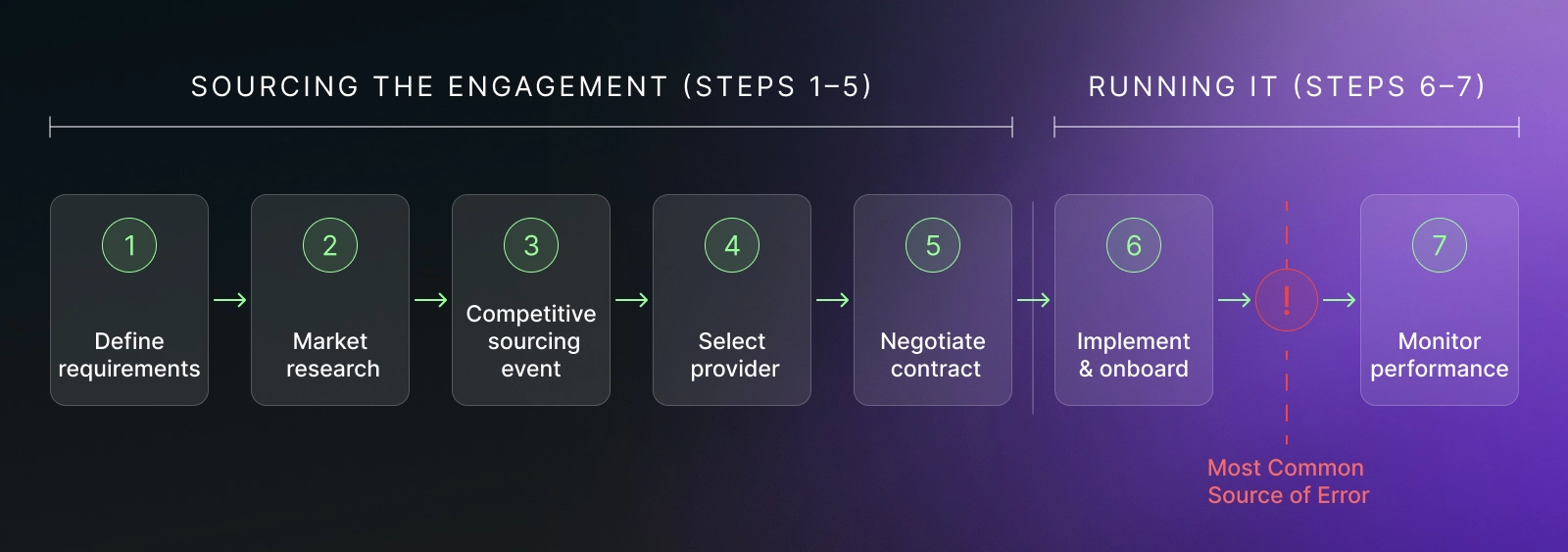
The process most often falls apart between steps six and seven. Once the engagement begins, day-to-day priorities crowd out ongoing performance management, contracts renew automatically because nobody is tracking the renewal date, and by the time anyone audits the relationship in detail, switching providers has become more disruptive than continuing with the incumbent. Mature teams close this gap by treating sourcing and ongoing contract lifecycle management as one continuous workflow. A connected contract management platform keeps obligations, clause deviations, and renewal dates visible from signature through to renewal, so silent renewals and lost negotiating leverage stop happening.
The most common failure modes in service procurement are the ordinary consequences of a process that nobody fully owns.
Maverick spend. Department heads bypass procurement to engage providers directly, often through existing relationships or through a vendor someone knows. Each individual decision feels reasonable to the person making it. Together, those decisions produce a fragmented supplier base spread across dozens of providers, with no consolidated view that procurement can use to negotiate better terms, exercise spend control, or rationalise the portfolio. This is one of the most common cost traps in service buying: paying more than necessary, repeatedly, for capability that the organisation already has under another contract.
Inadequate briefs. A weak or vague brief produces a poorly scoped SoW, which produces a deliverable that "isn't quite what we wanted." Fixing this in flight, once the engagement is already running, is several times more expensive than getting the brief right at the start.
Insufficient performance management. Many service contracts are signed and then ignored until the renewal date. Managing supplier relationships often involves multiple parties, both internal and external, and that coordination requires effective communication to keep service requirements aligned. Without active SLA tracking and clear quality standards, the buyer has no evidence base to push back when performance expectations are missed, the supplier has no incentive to perform above the minimum, and weak performance management remains one of the most persistent challenges procurement teams face when buying services.
Compliance and data security exposure. Service providers often need access to sensitive systems and confidential data to do their work. Without proper vendor due diligence at onboarding and clear data protection terms in the contract, the buying organisation remains liable under UK GDPR and the Data Protection Act 2018 if a provider mishandles customer or employee data, even when the breach occurred at the provider's end. Effective risk mitigation in service procurement starts at the contract stage, not after the fact.
Five principles capture what mastering service procurement looks like in practice. Together they form a structured approach to successful service procurement that turns it from a reactive exercise into a managed discipline.
Run an inclusive needs assessment. Bring the requesting business stakeholder, the relevant subject-matter expert, and procurement into the same conversation before drafting any brief. Vague requirements get expensive fast. Aligned requirements compound into better suppliers, better contracts, and better outcomes.
Find the right suppliers, beyond the incumbent roster. Most enterprises rely on a small set of incumbent providers and personal networks. A structured supplier discovery process, combining sector mapping, competitive RFPs, and peer references, surfaces the alternatives that the existing roster has crowded out.
Drive performance through digital collaboration. Service performance is judged on responsiveness, quality, and milestone delivery. Without a shared system of record, that judgement happens in inboxes and gets lost. A central platform with SLA tracking, milestone visibility, supplier performance dashboards, and the ability to manage service providers across categories from a single interface makes the conversation evidence-based.
Move from maverick spend to managed spend. Maverick spend rarely disappears through policy alone. It disappears when the alternative is faster and easier than going around procurement: a structured request and sourcing flow that takes minutes rather than days.
Shift from operative to guided buying. Operative buying is procurement transactionally executing requests. Guided buying is procurement structuring the choices upfront so the business stakeholder makes good decisions on their own. For services, guided buying turns the procurement team from a bottleneck into a multiplier.
Service procurement has historically been the hardest category to digitise, because so much of it depends on judgement and context. Modern service procurement solutions are changing that. AI agents close the gap between what service categories need and what procurement teams have time to deliver. They are software components that run defined procurement tasks, with human oversight on the consequential decisions.
The capabilities that matter for services specifically:
Automated SoW drafting from a structured brief. An AI agent takes a defined requirement and generates a first-draft SoW with the right scope sections, milestone structure, and SLA framework, ready for legal and category review.
Continuous supplier discovery. Rather than relying on the suppliers a buyer already knows, an AI agent surfaces qualified providers across the market for a specific scope, with relevant references and compliance signals attached.
Active performance monitoring. SLA tracking, milestone delivery, and obligation management run as real-time monitoring in the background, surfacing issues to the responsible buyer before they become escalations.
Contract intelligence. Clause analysis, deviation detection, and renewal tracking take the manual work out of service contract oversight.
McKinsey's analysis of digital procurement transformation finds that comprehensive digitisation reduces the manual effort involved in supplier governance by 30% to 50%, on top of the cost savings already cited. In service categories, manual effort is concentrated in performance monitoring and lifecycle management, which is exactly where digital tools and AI agents deliver the largest gains in operational efficiency, real-time monitoring, and cost optimisation. The same tooling generates data-driven insights and enhances transparency and accountability across the engagement lifecycle, sharpening every subsequent decision in the cycle.
The Mercanis platform deploys AI agents across the procurement lifecycle, with the buyer holding decision authority on the consequential choices: supplier selection, contract terms, and performance escalations. The agents handle the operational work in between.
Service providers routinely access sensitive systems, customer data, and internal information as part of doing their work: a consulting firm working on a strategy project sees confidential financials, an IT services provider holds privileged credentials, and a marketing agency processes customer contact data that falls under GDPR.
For UK organisations, the relevant regulatory framework includes the UK GDPR and the Data Protection Act 2018 for any provider processing personal data, the NIS Regulations 2018 for providers in critical infrastructure or digital services, and sector-specific regimes such as the FCA outsourcing rules in financial services or the NHS Data Security and Protection Toolkit in healthcare.
The procurement team's responsibility is to ensure these obligations are reflected in contractual safeguards before the provider gets access. Three controls do most of the work:
Vendor due diligence at onboarding. Security questionnaires, ISO 27001 or SOC 2 evidence, and data processing impact assessments where appropriate. Done at onboarding, this prevents harder conversations later and aligns the provider with the buyer's company policies on data and access from the outset.
Data protection clauses in the contract. The key terms here cover data location, sub-processor approval, breach notification timelines, audit rights, and data return or deletion at the end of the engagement.
Ongoing assurance. Compliance is not a one-time check. Annual reviews, quality assurance audits, monitoring of certification status, and supplier risk monitoring keep the assurance current as the engagement evolves.
The cost of getting this wrong is rarely just regulatory. Service-related data breaches damage trust with customers and partners in ways that take years to rebuild.

Goods procurement deals with tangible items that can be specified, inspected, and compared on price and quality. Service procurement deals with intangibles: consulting outputs, legal advice, agency creative, IT support, where quality emerges through human performance over time. Service contracting also relies on a different structure: Master Services Agreements, Statements of Work, and Service Level Agreements, rather than purchase orders against a catalogue.
Seven steps: define requirements, conduct market research, run a competitive sourcing event, select the provider, negotiate the contract, implement and onboard, then monitor performance through to renewal or termination. Most failures happen between steps six and seven, when performance management is neglected after the contract is signed.
An MSA is the umbrella contract that governs an ongoing commercial relationship with a service provider. It covers terms that apply across all engagements: liability, IP ownership, confidentiality, dispute resolution, and payment mechanics. Specific projects are then defined in Statements of Work that reference the MSA.
AI agents run defined procurement tasks end to end with human oversight on consequential decisions. For services, that includes automated SoW drafting, continuous supplier discovery beyond the existing network, active SLA and milestone tracking, and clause-level contract analysis at renewal. McKinsey research finds that integrated digital procurement platforms reduce manual supplier governance effort by 30% to 50%.
Contract lifecycle management is where the value of a service engagement is captured or lost. The signed MSA and SoW define the relationship. Ongoing contract management ensures it delivers what was agreed. Without it, service contracts drift, auto-renew silently, and lose negotiating leverage at renewal.


Fabian Heinrich is the CEO and co-founder of Mercanis. Previously he co-founded and grew the procurement company Scoutbee to become a global market leader in scouting with offices in Europe and the USA and serving clients like Siemens, Audi, Unilever. With a Bachelor's degree and a Master's in Accounting and Finance from the University of St. Gallen, his career spans roles at Deloitte and Rocket Internet SE.